Dreamland Margate: A Guide to the UK’s Iconic Amusement Park
Dreamland Margate is a seaside amusement park, entertainment and music venue, which history goes back to 1880 when the site was first used for amusement rides. The Dreamland name was not used until 1920 when the Scenic Railway wooden rollercoaster was first opened.
It has a great vintage and retro feel as many of the original rides have been recreated and the original wooden rollercoaster restored. It’s perfect for a family day out and I’ve always enjoyed visiting the park over the years – there is always something new to do or see – including the summer music festivals and concerts.
Over the years, the park went through several changes in ownership and name, including being sold to the Dutch Bembom brothers in 1981 and renamed “Bembom Brothers White Knuckle Theme Park”.
In the early 2000s, the park began to decline and faced closure, leading to a public campaign to restore and reopen Dreamland. The park was eventually acquired by Thanet District Council in 2013 and underwent a major redevelopment, reopening in 2015 as a “Re-imagined Dreamland”.
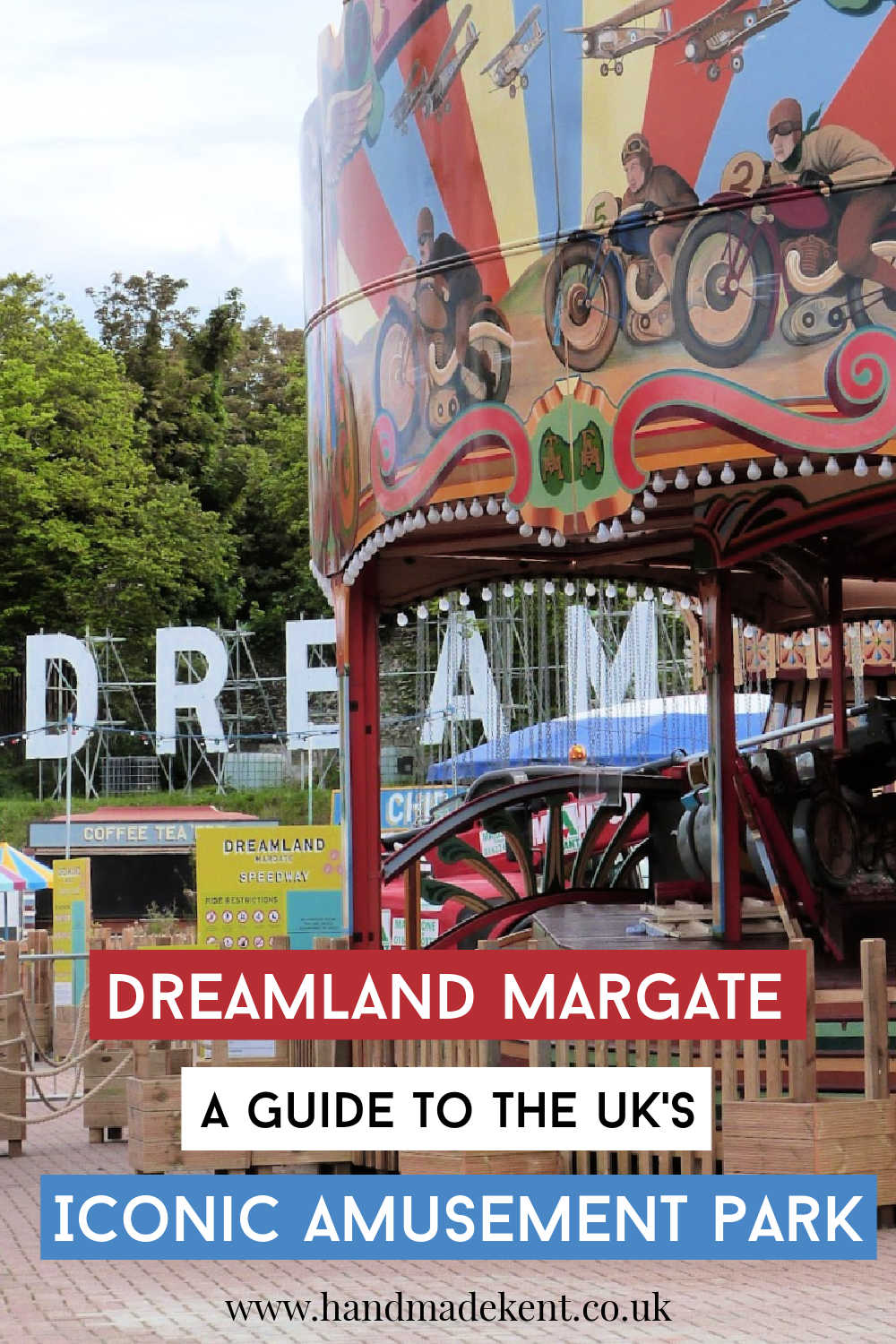
PIN TO KEEP FOR LATER
MORE PLACES TO VISIT IN MARGATE
- Visiting the seaside town of Margate >>
- The historic Tudor House >>
- Visit the vibrant Old Kent Market >>
Dreamland just before the re-opening in 2015
I’ve been lucky to visit Dreamland back in 2015 when site was being re-furbished. Before that I visited Margate for the first time back in 1999 when the Dreamland was still open, but on that date we didn’t get the chance to visit it.
But our next stop further down the seafront at the Dreamland Expo was altogether more rewarding. Set in a vintage style arcade, complete with faded period cornices, there is a collection of 1950’s and 1960’s arcade games and pinball machines as well as a fascinating array of fairground and amusement park paripanaleia.
It’s part of a bold plan to restore the much loved Dreamland amusement park and rides which last entertained the public over a decade ago. Originally site was the terminus for the Kent Coast Railway Company. Then it became known as the Hall by the Sea, and housed a music hall, an early Circus and Wild West shows, with the land behind being converted into a pleasure garden and a menagerie.
Bought after the war for the equivalent of around £2 million in today’s money, it was renamed Dreamland and became one of the UK’s first amusement parks with white knuckle rides that quickly became something to shout about – so much so that the terrified screams from day trippers could be heard loud and clear on the High Street and for miles out to sea.
Later a ballroom was added and a cinema. In the 1960’s all the top rock groups such as The Rolling Stones and The Who, played there and the surrounding seafront was where the Mods and Rockers Bank Holiday fights of 1964 set the scene for the emergence of modern pop youth culture.
Like many fairground attractions, its own fortunes were a roller coaster ride every bit as eventful as the Big Dipper itself. Its eventual fall was grace was equally spectacular. Like many half abandoned sites, it suffered from vandalism and fire before a Trust was set up to restore the Scenic Railway and amusement park.
Looking at the striking modernist Grade II listed dorsal fin frontage, this is an entertaining venture that captures the very emotional spirit of Margate.
Will the same be said of the Turner Contemporary building a century from now? It deserves to succeed.
Although it still looked very much a building site, the rides are being restored and plans are to re-open part of the complex later this year. Like the Big Wheel itself, Dreamland’s fortunes may just have come full circle, at last.
EXPLORE THE LOCAL SEASIDE
- Walpole Bay Beach close to Margate >>
- Kingsgate Beach: A perfect hideaway >>
- Visiting the Reculver Towers & Fort >>

Dreamland History
The site was originally a salt marsh called the Mere, which was only accessible at low tide until 1809 when a causeway and seawall were built. In 1846, the South Eastern Railway built a railway terminus on the present-day Arlington site, followed by a terminus for the London, Chatham and Dover Railway (LCDR) in 1864. The LCDR completed this terminus in 1866, but no public service was ever offered.
In 1870, London restaurateurs Spiers and Pond opened a restaurant and dance hall at the unused railway terminus on the Mere causeway. The ‘Hall by the Sea’ was bought by the Reeve family of Margate in 1870 for £3,750, who also gradually acquired the low-lying land at the rear of the Hall.
Circus entrepreneur George Sanger went into partnership with Thomas Dalby Reeve, the then Mayor of Margate, to run the ‘Hall by the Sea’ in 1870. After Reeve’s death in 1875, Sanger became the sole proprietor of the Hall and the land behind it.
The former ‘Mere’ land was turned into pleasure gardens with a mock ruined abbey, lake, statues, and a menagerie, as well as sideshows and roundabouts. Animal cages and Gothic walls on the present Dreamland western and southern boundaries date from this time.
The first amusement rides were installed as early as 1880 when ‘Sea on Land’ machines were installed. In 1893, a large skating rink was built. Shortly after this, the park gained notoriety as the venue for the murder of a girl by the local circus strong man.
The park expansion
The park entered an uncertain period after Sanger’s death in 1911. In 1919, John Henry Iles purchased the site for £40,000 and renamed it ‘Dreamland’.
He initiated work on the construction of the Scenic Railway rollercoaster in 1919, having purchased the European rights to the Scenic Railway design from inventor and patent holder LaMarcus Adna Thompson.
The ride opened to the public in 1920 with great success, carrying half a million passengers in its first year. Iles also brought other rides common to the time, including a smaller roller coaster, the Joy Wheel, Miniature Railway, The Whip, and the River Caves.
Dreamland between and during the wars
A ballroom was constructed on the site of the skating rink in 1920, and in 1923 Iles built his variety cinema on the site. Between 1920 and 1935 he invested over £500,000 in the site, constantly adding new rides and facilities and culminating in the construction of the Dreamland cinema complex in 1934. Iles ceased to be a director in 1938, and the business was taken over by his son Eric.
Most of the Dreamland site was requisitioned by the Government during World War II, with the park reopening in June 1946. Eric Iles was the manager. From 1947, it received investment from Butlins.
Three generations of the Iles family – John Henry, Eric, and John – controlled Dreamland from 1919 until its sale in 1968. The new owners, Associated Leisure, introduced many innovations to Dreamland, including squash courts and, in an echo of the Sanger era, an ice rink and zoo.
EXPLORE MORE KENT’S SEASIDE TOWNS
- The best things to do and see in Broadstairs >>
- The historic windmill in Herne village >>
- A great day at the seaside town of Whitstable >>
The Dreamland unfortunate decline
Margate’s economic base depended on residential holidaymakers staying for several days, usually families holidaying for a week or more. This was supplemented by day-trippers on weekends and public holidays when the resort could become very busy.
With the rise of cheap package holidays abroad from the 1960s, however, the residential holiday trade progressively collapsed in the 1970s. This meant that footfall at entertainment venues in these resorts, such as Dreamland, declined sharply on summer weekdays while remaining relatively buoyant at weekends.
Day-tripper trade at Margate remained substantial, but the loss of holiday revenue meant that the town began to struggle to maintain its infrastructure.
This, in turn, started to affect its attractiveness as a day destination. However, the investment by Bembom Brothers indicates that this was not regarded as an appreciable threat to Dreamland at the beginning of the 1980s.
More immediately serious was the opening of much larger amusement parks closer to London, on expansive sites and with ample vehicle parking. Thorpe Park opened in 1979, and Chessington World of Adventures in 1987. At this time, the fastest train journey from London to Margate was just under two hours, and Dreamland has never had any public on-site parking.
Dreamland Closure
Although it was initially announced that Dreamland would close in November 2003, it operated during 2004 and 2005. Definitive closure to the public was in 2005 and all of the rides apart from the Scenic Railway were then removed from the site. The Scenic Railway had been granted Grade-II listed status in 2002, and so could not be moved or dismantled.
The park’s famous rides and attractions
Dreamland Margate boasts a variety of rides and attractions that cater to visitors of all ages. The park is home to the Scenic Railway, a wooden roller coaster that was originally built in 1920 by J.H. Iles and was later rebuilt by WGH Ltd and Topbond Plc in 2015. The Scenic Railway is a popular attraction that provides riders with a thrilling experience.
Another popular ride at Dreamland Margate is the Beehive Coaster, which is a children’s roller coaster that was relocated from Luna Park Sunny Beach, Bulgaria. The ride was previously known as “Counter Culture Caterpillar” before being re-themed by Ben Irwin. The Beehive Coaster is a great attraction for families with young children.
Visitors can also enjoy the Dreamland Drop, a tower ride that was added to the park in 2018. The ride was manufactured by Zamperla and stands at 43 metres tall. The Dreamland Drop provides riders with a breathtaking view of the park and its surroundings.
For those looking for a more classic amusement park experience, Dreamland Margate offers a variety of vintage rides that have been refurbished to their former glory. The Dodgems, for example, were originally built by Lang Wheels in 1946 and have been refurbished by Littleboy’s Vintage Restorations. The Dodgems provide riders with a fun and exciting experience that is sure to bring back memories of classic amusement parks.
Other vintage rides at Dreamland Margate include the Cyclone Twist, the Chair-O-Plane, and the Waltzer. These rides have all been refurbished by Littleboy’s Vintage Restorations and offer visitors a chance to experience the charm and nostalgia of classic amusement park rides.
In addition to the rides, Dreamland Margate also features a variety of attractions such as the Mirror Maze and the Mary Rose Children’s Play Area. These attractions provide visitors with a chance to take a break from the rides and enjoy some family-friendly entertainment.
Music Festivals at the park
Dreamland has been a popular venue for various festivals and events. In 2017, the Demon Dayz festival was held at the park on 10 June. The festival was announced by Gorillaz on 6 March 2017 and sold out in just 32 minutes, with approximately 15,000 tickets sold in an hour.
In 2018, the National Citizen Service hosted their graduation ceremony at Dreamland, where 700 Kent and Sussex teens graduated from the employability programme. Each graduate received a signed certificate from the Prime Minister.
Dreamland on television and in film
You might have seen the glimpse of Dreamland in many films and on television, but here is a little reminder of the main examples:
- In the 1953 documentary film O Dreamland, the park was the main subject.
- Dreamland was visited by characters in the 1989 Christmas special of the BBC Television sitcom Only Fools and Horses titled “The Jolly Boys’ Outing”. Some of the rides seen in the show were renamed and repainted at Loudoun Castle Theme Park in Scotland, which is now closed. The Mary Rose ride was renamed the Black Pearl and is now located at Lightwater Valley in North Yorkshire.
- The park was the filming location for the 2007 film Exodus and was also featured prominently in the 2000 film Last Resort, which tells the story of a young Russian immigrant seeking asylum in England.
- Dreamland is frequently mentioned in Graham Swift’s 1996 novel Last Orders and the 2001 film adaptation.
- The Romford-based band Five Star shot the majority of the music video for their 1984 single “Crazy” at Dreamland.
- The music video for the song “Blue” by Marina and the Diamonds was shot at Dreamland in 2015.
- In 2017, the Sky Mobile iPhone 8 commercial featuring actor Tom Hardy was shot at Dreamland.
- In February 2022, the Dreamland Cinema signage was changed while the building was used as a set in Sam Mendes’ 1980s period film Empire of Light.
- In June 2022, Noel Gallagher’s High Flying Birds performed at Dreamland.
Practical Information for visiting Dreamland Park in Margate in 2024
Location: Dreamland Margate Marine Terrace, Margate CT9 1XJ
Opening Times:
- During school holidays, Dreamland is open daily from 10am to 6pm.
- Outside of school holidays, Dreamland is open on weekends only in the winter season
- The park is closed on Tuesdays and Wednesdays year-round.
- Summer season opening times -Thursday – Sunday
Ticket Prices
- Individual ride tickets start from £2 per ride. Prices vary by ride.
- Wristbands give unlimited access to rides. Prices are £15 off-peak, £22 peak per person.
- Family wristbands (2 adults, 2 children) are £50 off-peak, £75 peak. Additional children are £10 each.
- Annual passes are available from £59 per person. Discounted family passes are also available.
- Group tickets: 10+ tickets are £12 off-peak, £18 peak per person.
- Under 1.2m tall enter free. Over 60s get 25% off wristbands.
Parking
- Dreamland has an onsite pay-and-display car park with approximately 500 spaces.
- The onsite car park charges a flat daily rate of £9 for parking. This applies to all parking spaces including accessible spaces.
- Parking fees are charged from the moment you enter the car park gates. You must pay even if just dropping off (and people are being charged and getting fines for entering the car park or leaving few minutes after the time they paid for, so be careful)
- There are other car parks within walking distance of Dreamland such as Mill Lane car park which is free on Saturdays.
- Street parking is also available near Dreamland but charges may apply.
How to get to Dreamland in Margate (from London)
The fastest and most direct option is the direct train from London St Pancras to Margate. The coach is cheaper but slower. Driving takes 2+ hours but allows more flexibility.
- Train from London St Pancras to Margate – Direct trains take around 1 hour 30 minutes. Tickets start from £10.50 one-way.
- Coach from London Victoria Coach Station to Margate – National Express coaches take around 2 hours. Tickets start from £5 one-way.
- Drive from London – Margate is around 135 miles from central London via the M2/A2. The drive takes around 2-2.5 hours depending on traffic.
- Combine train and bus – Train to Canterbury or Ramsgate, then bus/taxi to Margate.
This blog post was originally published on 23 January 2024 and last updated on 23 January 2024


