The 13 Most Remarkable Churches in Kent Worth Visiting
I think, it’s fascinating, that Kent has the highest number of churches in all the counties in England. There are between 800 and 1,000 churches in total with about half of these still active Church of England parish churches, plus hundreds more across other denominations like Baptist, Methodist, Catholic and Pentecostal.
The rest are historic churches that are no longer used for regular services, with many looked after by the Churches Conservation Trust or converted into private homes.
The reason, why Kent has so many churches is quite simple. This is where English Christianity actually began, with St Augustine arriving in 597 AD and founding St. Augustine in Canterbury. Here, you can also find the oldest parish church (St.Martin’s) in continuous use in the English-speaking world.
Kent is also the only English county with two cathedrals (Canterbury and Rochester), and more than 400 of its churches are Grade I or Grade II* listed, which is pretty impressive.
I love visiting old churches, mostly for the history side of things. Every single one has a story to tell, whether it’s a Saxon doorway, a medieval wall painting a quirky tomb or a famous person buried in the churchyard.
Honestly, picking just 13 churches for this list was tough because every church in Kent is interesting in one way or another and I could happily have written about 50 of them. But these are the ones I keep coming back to, either because the history is extraordinary, the building is unusual, or there’s a brilliant story attached.

1. Canterbury Cathedral, Canterbury
I know, I know, the obvious choice, but you genuinely can’t write about Kent churches without it.
Thomas Becket was murdered here in 1170 by knights who took King Henry II’s frustrated words a little too literally and within three years the Pope had made him a saint.
The pilgrimage trade that followed inspired Chaucer’s Canterbury Tales and the cathedral became one of the most important Christian sites in medieval Europe.
The Bell Harry Tower, finished in 1498, still chimes today. I like walking around the cathedral, because you get to see how extensive the grounds are with lots of outbuildings, ruins and even a secret garden. If you want to visit during the day, you need to pay for a ticket, but you are always welcome to join the service or visit the outside of the cathedral after opening hours for free.
- Location: Cathedral House, 11 The Precincts, Canterbury, CT1 2EH
2. St Mary’s Church, Higham
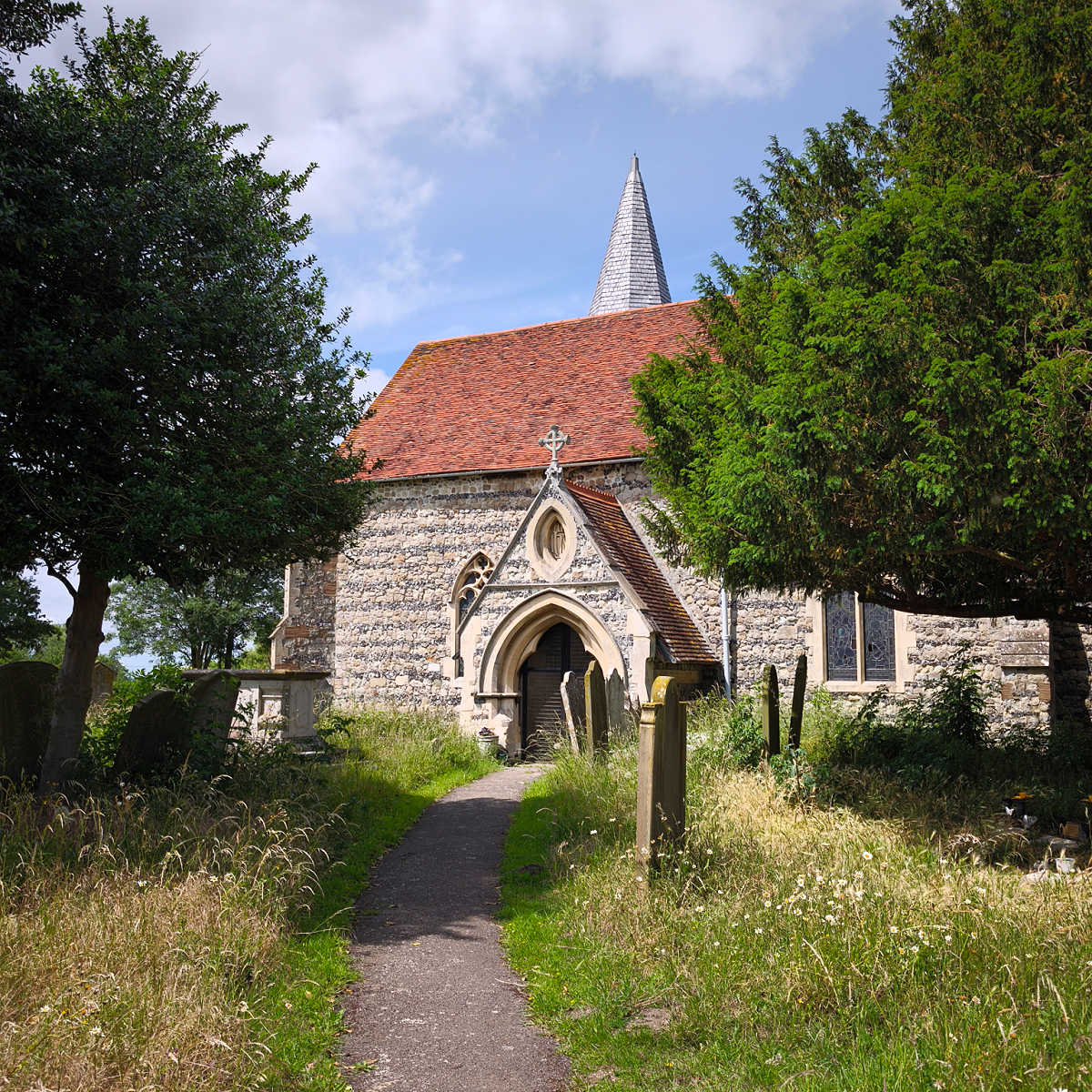
Charles Dickens, one of the most famous literary figures in Kent, used to walk here from his home at Gad’s Hill Place, and you can absolutely see why he loved it. His daughter Katey was married here in 1860 and the local marches inspired him to describe the country scenes in Great Expectations.
This little medieval church is completely on it’s own at the end of a country track, next to few houses, surrounded by fields, which feels completely forgotten by time. It’s actually two churches in one, with a 13th-century nave and a 14th-century addition and it was once part of a Benedictine nunnery.
The church fell out of use as the village moved to a new location, leaving it stranded out in the countryside. It’s now cared for by the Churches Conservation Trust and walking up to it on a misty morning is genuinely atmospheric.
- Location: Church Street, Higham, ME3 7NN

3. Rochester Cathedral, Rochester
I always pop in to Rochester Cathedral, whenever I visit Rochester, because there is always something new to see.
For example, Rochester Cathedral installed a temporary mini golf course in 2019, which caused quite a stir but got people through the doors! Last time I visited, there was a great exhibition about the local industry with a large airplane in the middle of the cathedral. It was amazing so see!
This is England’s second oldest cathedral, but often overshadowed by its big sister in Canterbury. I think this is a real shame, because there is so much interesting history and unlike Canterbury, it’s also completely free to visit.
The cathedral was founded in 604 AD by Bishop Justus. The Norman west front is wonderful to look at and the crypt is one of the largest in England.
What I find fascinating is the medieval graffiti scratched into the walls by pilgrims who came to visit the shrine of William of Perth, a baker who was murdered nearby in 1201.
Charles Dickens wanted to be buried here, though he ended up in Westminster Abbey instead. His memorial is in the south transept.
- Location: Garth House, The Precinct, Rochester, ME1 1SX
4. St Martin’s Church, Canterbury
This is the oldest church in the English-speaking world still in continuous use, which I still find amazing every time I visit.
St Martin’s was already standing when St Augustine arrived in 597 AD and Queen Bertha of Kent worshipped here before her husband King Æthelberht converted to Christianity.
You can actually see Roman bricks built into the walls, which is super cool when you think they were laid down before England was even England. It’s a UNESCO World Heritage Site alongside the Cathedral, but it’s far quieter and more atmospheric. There is also a little churchyard with interesting gravestones, including the tomb of children’s author Mary Tourtel, who created Rupert Bear.
- Location: North Holmes Road, Canterbury, CT1 1PW

5. St Leonard’s Church, Hythe
The ossuary beneath St Leonard’s in seaside town of Hythe is one of only two surviving in Britain and walking down those stone steps for the first time is something you don’t forget in a hurry.
There are around 1,200 skulls and 2,000 thigh bones neatly stacked on shelves, all dating from medieval times. Nobody knows exactly why they ended up here, though theories range from plague victims to bones cleared from the overcrowded graveyard in the 13th century.
Recent studies suggest they’re mostly from local people who lived between the 13th and 15th centuries, and the collection has become a fascinating resource for scientists studying medieval health and diet.
The church above is wonderful too, with a soaring early English chancel that’s one of the tallest in any English parish church, built around 1220. There’s been a church on this site since Saxon times, and you can still see fragments of Norman work in the nave arcades. The church is free to enter during the day, but the admission to the ossuary is payable (last time I visited, it was £5 for adult ticket)
- Location: Oak Walk, Hythe, CT21 5DN
6. All Saints Church, Tudeley
This is the only church in the world to have all twelve windows designed by Marc Chagall, which is pretty extraordinary for a small village church in Kent.
The story behind it is heartbreaking and lovely in equal measure. Sarah d’Avigdor-Goldsmid drowned in a sailing accident in 1963, and her parents commissioned Chagall to create a memorial window. He liked the church so much that he returned over the following years to design the rest, finishing the final window in 1985 when he was 97. The blues and yellows are stunning in afternoon light, so it’s best to visit on a sunny day to really appreciate them.
- Location: Hartlake Road, Tudeley, TN11 0NZ

7. St Lawrence’s Church, Mereworth
I found this church almost by accident, when I was on my way back home from walking on the Medway Valley Path nearby. The story behind this church is fascinating and I think it says everything about 18th-century aristocratic priorities.
John Fane, the 7th Earl of Westmorland, decided his grand new Palladian villa at Mereworth Castle needed more privacy, so he simply moved the entire village further down the road and built them a new church as compensation. Cheeky, but at least he didn’t skimp on the replacement.
Built between 1744 and 1746, it’s thought to have been designed by Colen Campbell, the Scottish architect who also designed Mereworth Castle itself and was a key figure in bringing the Palladian style to London, including work on Burlington House.
The church spire was modelled on St Martin-in-the-Fields in Trafalgar Square in London and looks very stylish and way too glamorous for this part of Kent countryside. Inside, the painted ceiling and classical columns make you feel like you’ve wandered into a small Italian church rather than a Kent village one.
- Location: The Street, Mereworth, ME18 5NA
8. St Thomas à Becket Church, Fairfield
If you want a proper adventure, this is the one. This church is in the middle of Romney Marsh with no road, no village and often surrounded by water when the marshes flood. You have to collect the key from a nearby farm and walk across the fields to reach it or you can just view it from outside.
The current building dates from the 18th century, though there’s been a church here since the 13th. Inside, the white box pews and triple-decker pulpit are beautifully preserved and pretty much unchanged for 200 years. Derek Jarman filmed scenes here and it’s appeared in countless period dramas.
- Location: Fairfield, Romney Marsh, TN29 9RX

9. St Augustine’s Church, Ramsgate
Augustus Pugin considered this his finest work and he should know because he designed and paid for it himself! The architect behind the Houses of Parliament interiors and Big Ben’s clock tower built this church right next to his own home, The Grange, between 1845 and 1851.
He wanted to create the perfect medieval Catholic church and you can feel his obsession with Gothic detail in every corner, from the carved stonework to the encaustic floor tiles.
Pugin is buried in the family vault here, which feels right somehow.
The church sits just along the coast from Ebbsfleet, where St Augustine landed in 597 AD to bring Christianity to England, so the dedication makes perfect sense.
It became a Shrine in 2012 and is now a place of pilgrimage again, which I think Pugin would have loved.
The church is free to enter during most days and the Grange is open few days a year for an open day (and it’s definitely worth visiting). I’ve been a few times now and every time I found something different, I’ve missed last time.
- Location: St Augustine’s Road, Ramsgate, CT11 9PA
10. St Clement’s Church, Old Romney
Another Romney Marsh wonder, this one was painted pink inside for a 1962 Disney film adaptation of Doctor Syn and the parish decided they rather liked it, so it stayed. The box pews are still that lovely soft pink colour today.
The church itself dates from the 11th century, with later medieval additions and the leaning pillars give the whole place a wonderfully wonky character. There’s a minstrels’ gallery from the 18th century, which is interesting to see in such a small country church.
- Location: Old Romney, Romney Marsh, TN29 9SX
11. St Mary Magdalene, Cobham
The brasses here are some of the finest in England and brass-rubbing enthusiasts travel from all over to see them. There are eighteen medieval brasses commemorating the Cobham family, dating from 1320 to 1529, which is an amazing collection.
Charles Dickens knew this church well, as he often walked over from Gad’s Hill and mentioned the Cobham village in The Pickwick Papers.
The almshouses next door, founded in 1598 by William Brooke, Lord Cobham, are still in use today. I love how the church and village have barely changed since Dickens’s time and the Leather Bottle pub across the way is a great place for lunch afterwards.
- Location: The Street, Cobham, DA12 3BZ
12. St Augustine’s Church, Brookland
The detached wooden bell tower is what everyone comes to see and it really is one of the strangest things in Kent. Built in the 13th century, it looks rather like a witch’s hat plonked next to the church and local legend claims it jumped off the church in surprise when a virgin came to be married. The truth is probably more practical, as the marshy ground couldn’t support the weight of a stone tower.
Inside, there’s a wonderful lead font from around 1170, decorated with the signs of the zodiac and the labours of the months. It’s one of only about 30 medieval lead fonts left in England.
- Location: High Street, Brookland, TN29 9QR
13. St Mary’s Church, Patrixbourne
The Norman south doorway here is genuinely one of the best examples of Romanesque carving in England, with intricate beasts, foliage and a Christ in Majesty in the tympanum that’s survived nearly 900 years remarkably well.
The Swiss stained glass inside is also pretty special, brought over in the 19th century and dating from the 16th and 17th centuries.
The village itself is lovely, with flint cottages and a stream running through and the church is right at the heart of it all. I always tell friends visiting Canterbury to drive the extra ten minutes out here to see it.
- Location: The Hill, Patrixbourne, CT4 5BP
This blog post was originally published on 10 June 2026 and last updated on 10 June 2026


