Kent Literary Guide: 16 Amazing Places Where Famous Authors Lived and Wrote
When I moved to Kent nearly 30 years ago, it honestly felt like Charles Dickens was the only writer anyone ever mentioned as his name seems to crop up in practically every village you pass through! But over the years, I’ve come to realise that our little corner of England has been a magnet for all sorts of brilliant authors, from Jane Austen and Virginia Woolf to Ian Fleming and E. Nesbit.
There’s something thrilling about finishing a great book and then heading out to stand in the very spot where it was written or where the main character in the book walked. Suddenly the pages come alive in a way that no museum or biography ever quite manages.
So I’ve pulled together this little insider’s guide to my 16 favourite literary places across Kent where you can learn more about your favourite writer or visit the place that inspires you to read the book afterwards.

1. Broadstairs & Charles Dickens
You’ll find that Charles Dickens absolutely loved our Kent coastline, but Broadstairs was his ultimate favourite holiday spot. He spent his summers here between 1837 and 1851, writing parts of David Copperfield and Nicholas Nickleby right by the sea. I really like visiting the Charles Dickens Museum here, which is set in the house that inspired the home of Betsey Trotwood. The building is incredibly old and the museum displays his personal letters and even his writing box!
Another house, where Dickens often stayed was Bleak House. I was lucky enough to visit the house when it was a Charles Dickens museum back in early 2000s. The house changed owners several times since then, but the good news is that the house has reopened as Havisham & Cratchit, a super cool vintage antique shop and lovely cafe where you can browse local crafts, enjoy delicious cakes, and even come for the regular Sunday farmer’s markets out in the garden overlooking the beautiful Broadstairs bay!
- Location: Victoria Parade, Broadstairs CT10 1QS
- Opening Times: Wednesday to Sunday, 1:00 PM to 4:30 PM (April to October)
- Tickets: Adults £5.50, Concessions £4.00, Children £3.00

2. Sissinghurst Castle Garden & Vita Sackville-West
I love visiting Sissinghurst, especially when the summer flowers are out and the colours are just incredible. The famous writer and poet Vita Sackville-West bought this ruined property in the 1930s with her husband, Harold Nicolson and they transformed it into one of the most beautiful gardens in Kent. You can climb up the super tall Elizabethan writing tower where Vita kept her private study. Her writing room is preserved exactly as she left it, with her books and inkwells completely untouched.
- Location: Biddenden Road, near Cranbrook TN17 2AB
- Opening Times: Daily from 11:00 AM to 5:30 PM
- Tickets: National Trust Members free; Standard adult tickets £15.00

3. Rochester & Charles Dickens
I have to mention Rochester as another location for Charles Dickens, because he spent the final years of his life at Gad’s Hill Place nearby and he used Rochester as the backdrop for so many stories. You’ll find Restoration House right in the centre of town, which is the exact historic mansion he renamed Satis House for Miss Havisham in Great Expectations.
The local Rochester Guildhall Museum also has a whole room dedicated to Dickens, so it’s definitelly worth visiting if you have an hour spare.
If you head to the back of Eastgate House on the High Street you can see Dickens’ original Swiss writing chalet. The chalet was a Christmas gift sent to Dickens in 1864 by his close friend, the French actor Charles Fechter. It arrived at the local railway station packed flat inside 58 separate boxes, complete with a long set of instructions written entirely in French. Dickens eagerly tried to assemble the two-storey wooden kit himself alongside a few friends, but they failed so miserably that he eventually had to call in the stage carpenters from the Lyceum Theatre in London to get the thing upright!
Once it was built in the gardens of his home at Gad’s Hill Place, it became his absolute favourite summer writing retreat. He loved the peace of the space so much that he spent his very last conscious day alive inside it, working on the final chapters of The Mystery of Edwin Drood on 8 June 1870, just before suffering his fatal stroke. The chalet was eventually moved to the back of Eastgate House in the 1960s, and while you can’t walk inside it right now because it’s so fragile, standing in the quiet garden and looking at its intricate wooden balconies is a wonderful experience.
When you need a break, pop into the Deaf Cat Coffee Shop on the High Street. It is a brilliant local spot named after Dickens’ own favourite pet, and they make a wonderful flat white and great homemade cakes.
- Location: High Street, Rochester ME1 1PX (Restoration House is located on Crow Lane)
- Opening Times: High Street accessible anytime; Restoration House opens Thursdays and Fridays from 10:00 AM to 4:45 PM during summer
- Tickets: Walking the town is free; Restoration House entry is £10.00 for adults

4. Knole House & Virginia Woolf
Knole is a fascinating place, not only because it is one of the largest historic houses in England. The writer Virginia Woolf was totally inspired by Knole House & Park and her relationship with Vita Sackville-West, who grew up here. Woolf wrote her famous novel Orlando as a literary love letter to Vita and Knole itself. The original manuscript of the book is actually kept right inside the house!
Walking through the stone courtyards is an amazing experience, and you can see the wild deer roaming completely free across the beautiful parkland.
- Location: Knole Park, Sevenoaks TN15 0RP
- Opening Times: Park open daily from dawn to dusk; House open 11:00 AM to 4:00 PM
- Tickets: National Trust Members free; Standard adult house tickets £16.00

5. St Margaret’s Bay & Ian Fleming
St Margaret’s Bay and the local area were a great inspiration for Ian Fleming. The James Bond creator actually bought his beautiful beachfront weekend cottage, White Cliffs, from his good friend Noël Coward in 1952.
The setting here is absolutely amazing, and numerous references to Kent appear right throughout the James Bond books. He loved the local landscape so much that he used the rugged hills just behind the house as the backdrop for Moonraker, the dramatic cliffside rocket launch site in the novel is based exactly on this place.
Fleming was extremely fond of playing golf at the Royal St George course at Sandwich and he used that exact location as the “Royal St Mark” golf course for Bond’s famous match in Goldfinger.
If you want a great day out, you can walk across the gorgeous Front Leas clifftop path from St Margaret’s Bay up towards Dover for some wonderful views across the Channel.
- Location: Beach Road, St Margaret’s Bay, Dover CT15 6DX (White Cliffs house); The Duck Inn is at Pett Bottom, near Canterbury CT4 6HD.
- Opening Times: The beach and coastal paths are accessible 24/7; The Duck Inn opens daily from 12:00 PM for lunch and dinner.
- Tickets: Free to walk the coast and explore the hamlet.

6. Down House & Charles Darwin
I love visiting Down House because, whilst it is a place where science history completely changed, it’s also a very cosy family home. Charles Darwin lived in this beautiful country home for forty years and it is where he wrote On the Origin of Species. You can stand right inside his study, which is preserved wonderfully with his original desk, chair and even his old specimen bottles still sitting on the shelves.
Saying that, my favourite part of visiting is definitely walking his famous “Sandwalk.” This was Darwin’s private “thinking path” in the garden, a lovely gravel loop where he would walk multiple times a day to work out his theories.
If you walk across the orchard, you will also see the greenhouses where he ran all his amazing botanical experiments.
I used to work at Down House as a house steward for a while, so I know the house well. My only beef with Darwin, as somebody who loves books, is that he used to tear books in half if there were too big so that he can read them better!
- Location: Luxted Road, Downe, Orpington BR6 7JT
- Opening Times: Wednesday to Sunday, 10:00 AM to 5:00 PM (times vary slightly by season)
- Tickets: English Heritage Members free; Standard adult tickets £16.30

7. Goodnestone Park & Jane Austen
If you want to experience a scene straight out of a classic novel, Goodnestone Park is a fascinating place to visit. Jane Austen was a frequent visitor here because her brother, Edward, married into the Bridges family who owned the estate. She stayed with her brother regularly in the 1790s and it was the elegant atmosphere of Goodnestone that completely inspired her to write Pride and Prejudice.
The house itself is super cool, but the gardens are the real highlight. I love visiting when the walled garden is in full bloom because the colours are completely beautiful and there is such a quiet atmosphere. You can follow the lovely “Serpentine Walk,” a winding pathway through the woodland that Jane herself used to stroll along while thinking up her characters.
The The Old Dairy Cafe right on the estate is great for afternoon teas, homemade lunches and delicious cakes!
Beyond Goodnestone Park, Jane Austen also spent time at Godmersham Park near Ashford, a gorgeous estate owned by her brother Edward after he moved from Goodnestone. This house directly inspired the grand houses and country life she wrote about in Mansfield Park and Sense and Sensibility.
She also frequently visited the busy market town of Sevenoaks and stayed at the Red House on the High Street.
- Location: Goodnestone, near Canterbury CT3 1PL
- Opening Times: Gardens open Sunday to Thursday, 11:00 AM to 5:00 PM (April to October)
- Tickets: Adults £8.00, Children £3.00

8. Canterbury & Christopher Marlowe
Canterbury is the birthplace of the Elizabethan era’s most scandalous bad-boy playwright, Christopher Marlowe. Born here in 1564 (the exact same year as Shakespeare!), Marlowe was the son of a local shoemaker, but was lucky enough to win a scholarship to The King’s School right in the cathedral precincts.
He went on to write masterpieces like Doctor Faustus, but he lived a wild life filled with secret espionage, brawling and atheism before his mysterious, violent murder in a Deptford lodging house at just 29.
I love visiting Canterbury to trace his early steps because so much of the Tudor city layout is still completely visible, such as the Marlowe Kit on Stour Street, which is a wonderful building that used to be a poor priests’ hospital.
- Location: The Marlowe Kit, Stour Street, Canterbury CT1 2NZ (The main Marlowe Theatre is located nearby at The Friars, CT1 2AS)
- Opening Times: The streets and exterior historic sites are accessible anytime; The Kit building hosts varying exhibition hours depending on seasonal events.
- Tickets: Free to explore the historic lanes and trail sites.

9. Whitstable & Julie Wassmer
You’ll find that while Kent has plenty of incredibly old literary connections, it is also home to some super cool modern mysteries. The famous Whitstable Pearl Mysteries is a wonderfully popular British cozy mystery series written by local author Julie Wassmer. The books follow the brilliant adventures of Pearl Nolan, a single mother who runs a booming seafood restaurant but decides to follow her dream of becoming a private investigator. It has become such a massive hit that it was even adapted into a major television series starring Kerry Godliman!
I love visiting Whitstable on a sunny afternoon because the books captures the spirit of the town so perfectly. If you walk across the busy harbour past the traditional black wooden oyster shacks, you can see the local fishing boats.
- Location: Whitstable Harbour and High Street, Whitstable CT5 1AB
- Opening Times: The harbour and beaches are open 24/7; individual shops and restaurants generally open daily from 10:00 AM to 5:00 PM.
- Tickets: Completely free to explore the town

10. Dover & William Shakespeare
William Shakespeare was born in Stratford-upon-Avon, but he spent plenty of time touring the country with his theater group and he is said to have inspired by the white cliffs of Dover when writing his tragic masterpiece King Lear.
The incredible chalk headland just to the west of the town was even featured in a deeply poetic passage of the famous play, where the blinded Earl of Gloucester asks to be led to the very edge of the cliff. Because of that exact connection, the headland was later named “Shakespeare Cliff,” and it still stands majestically today!
I really like exploring this section of the coast because the views over the English Channel are completely amazing. My favourite part is the 7 miles walk from Folkestone to Dover, which takes past the Capel and past Samphire Hoe, where you can see how the modern Channel Tunnel was built right underneath the Shakespeare Cliff.
I also think, it’s quite fitting, that it was under the Shakespeare Cliff, where they found the first coal in Kent, which started the fasctinating, but rather short lived local mining history .
- Location: Shakespeare Cliff, Upper Road, Dover CT17 9HD
- Opening Times: The cliffs and coastal walking trails are open daily from dawn to dusk.
- Tickets: Completely free to access the paths and viewpoint.

11. Canterbury & Geoffrey Chaucer
I cannot possibly talk about literary Kent without mentioning the brilliant world of Geoffrey Chaucer and his legendary Canterbury Tales.
Written in the late 1300s, this incredibly famous collection of stories follows a group of colourful pilgrims, ranging from a knight to a married woman, as they travel from London to the shrine of Saint Thomas Becket right inside Canterbury Cathedral.
It might sound like a dry bit of compulsory school reading, but Chaucer’s writing is actually brilliantly funny.
While the journey famously ends right at the cathedral gates, Chaucer mentions quite a few Kent places along the route.
The book mentions Ospringe (near Faversham) where the pilgrims stayed overnight, Boughton under Blean (referred to as ‘Boghton under Blee’), where a mysterious canon and his yeoman frantically ride to catch up with the group and the village of Harbledown. Chaucer playfully calls Harbledown “Bob-up-and-down” because of its rolling landscape. It is the very last stop on the journey where the travelers finally see the first magnificent glimpse of Canterbury Cathedral’s towers!
- Location: Buttermarket Square, Canterbury CT1 2HW (The Cathedral entrance is directly adjacent)
- Opening Times: The public square is open 24/7; Cathedral opening times are generally Monday to Saturday, 9:00 AM to 5:00 PM, and Sunday for services.
- Tickets: Walking the historic streets and Buttermarket square is completely free; Cathedral entry tickets are £17.00 for adults (free for kids and local precinct pass holders).

12. Halstead, Yalding, Dymchurch & E. Nesbit
The wonderful children’s author E. (Edith) Nesbit absolutely loved the Kentish countryside and she spent a big part of her life exploring and writing about Kent’s beautiful villages.
Because her family moved around quite a lot, she lived in various corners of Kent, including a three-years at Halstead. It was during her time living in this lovely place that she got the brilliant idea for her most famous book, The Railway Children. The train station she used for inspiration was originally called “Halstead for Knockholt” before it formally became “Knockholt” in 1900.
Nesbit had an amazing eye for spotting the most beautiful places to stay. In her novel The Incredible Honeymoon, she explicitly tells her readers: “If you go to Yalding you may stay at the George and be comfortable in a little village that owns a haunted churchyard, a fine church, and one of the most beautiful bridges in Europe.”
After falling in love with the coast, Nesbit eventually settled down in the seaside town of Dymchurch, which had always been her absolute favourite holiday destination. When she passed away, she was buried in the nearby, quiet churchyard at St Mary in the Marsh.
- Location: St Mary the Virgin Church, St Mary in the Marsh, Romney Marsh TN29 0BX (Nesbit’s resting place); Yalding Bridge is located on the B2162, Yalding, Maidstone ME18 6JP.
- Opening Times: The churchyard at St Mary in the Marsh and the public historic bridges are accessible 24/7
- Tickets: Completely free to explore the villages, trails, and churchyards.
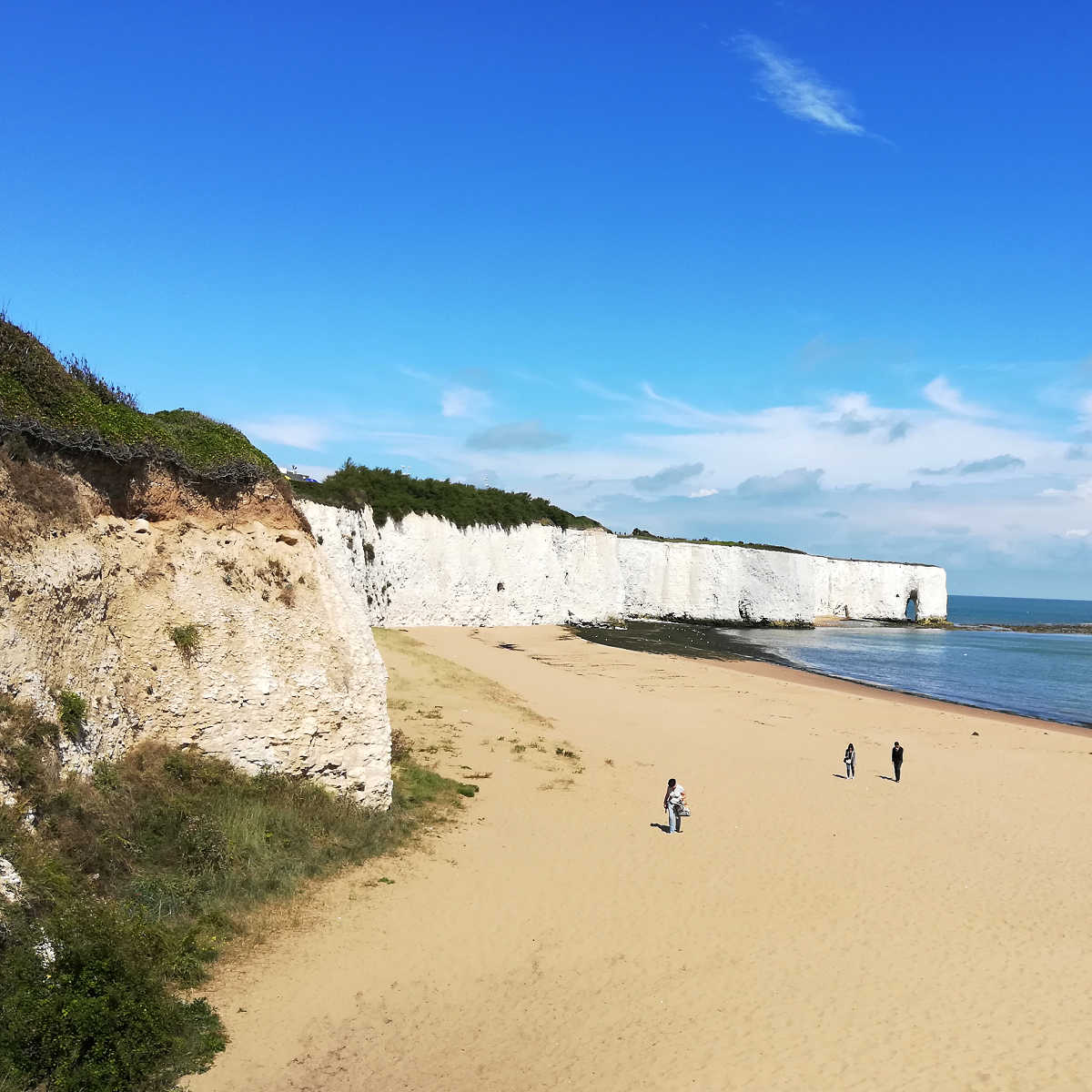
13. The Isle of Thanet & Wilkie Collins
Collins was a fascinating character who essentially invented the modern English detective novel and he completely fell in love with the dramatic coastal scenery around this corner of Kent. During his visits, he admired the striking white structure of the North Foreland Lighthouse, which inspired his famous mystery masterpiece, The Woman in White.
If you walk across the clifftop paths heading north from Viking Bay towards Kingsgate, you will get a great, uninterrupted view of the lighthouse standing proud against the sky. It is super cool to stand on the path and imagine Collins watching the lighthouse lantern flash across the dark sea while plotting his eerie gothic tales.
For a wonderful walking route, follow the Viking Coastal Trail path as it curves around to Botany Bay, where the towering white chalk stacks look completely amazing at low tide. After a breezy walk, treat yourself to lunch at The Captain Digby pub on Whiteness Road. It is a lovely, family-friendly cliffside pub overlooking Kingsgate Bay Beach where you can sit back and enjoy your food, their traditional Sunday roasts are absolutely delicious!
- Location: North Foreland Road, Broadstairs CT10 3NJ
- Opening Times: The coastal trail and viewpoints are open 24/7; the lighthouse itself is now automated and the grounds are privately owned, so it is viewed from the public path.
- Tickets: Completely free to walk the trail and enjoy the views.
14. Bishopsbourne & Joseph Conrad
Polish-born Jozef Teodor Konrad Korzeniovski might not have found acceptance with nineteenth-century British readership had he not been published under his anglicised name, Joseph Conrad. He spent large part of his life in Kent, including living at Capel House in Orlestone and Pent Farm near Sandgate.
But, his ultimate home was ‘Oswalds’ a beautiful country house opposite the parish church in the quiet village of Bishopsbourne, where he lived from 1919 until his death in 1924.
- Location: Charlton Park (opposite St Mary’s Church), Bishopsbourne, Canterbury CT4 5JA
- Opening Times: The village lanes, churchyard, and walking trails are open 24/7; Oswalds itself is a private residence and viewed from the road only.
- Tickets: Completely free to explore the village and follow the walking trails.
15. Little Chart & H.E. Bates
Herbert Ernest Bates purchased a derelict old granary in the pretty village of Little Chart, which he and his wife lovingly restored and lived in for more than 40 years. He was a very keen gardener, turning the acre of rough ground surrounding his home into a magnificent garden and writing several gardening books while doing so.
His most famous work was of course, the The Darling Buds of May, but he also wrote for the RAF’s wartime public relations department under the pseudonym Flying Officer X.
- Location: The Old Granary, Forstal Lane, Little Chart, Ashford TN27 0QA
- Opening Times: Public footpaths and village trails are open 24/7; The Granary is a private home and viewed from the road only.
- Tickets: Completely free to explore the village and walk the local trails.
16. Romney Marsh, Aldington & Noël Coward
Playwright, composer and actor Noël Coward lived in Romney Marsh long before he moved to the Kent coast. He lived at Goldenhurst a beautiful country estate in the area, and he became so involved in the local community that he actually served as the very last Chairman of the parish of Hurst before it was incorporated into the parish of Aldington! He absolutely loved the quiet atmosphere of the marshlands, living there happily until his beloved house was requisitioned by the army during the war.
When he needed somewhere to live while wartime restorations were in progress back at his estate, Coward purchased ‘White Cliffs’ right on the beachfront in St Margaret’s Bay close to Dover.
While living there, Coward wrote his smash-hit comedy Blithe Spirit, alongside transforming his brilliant stage plays This Happy Breed and Still Life into iconic film scripts, the latter of which became the world-famous classic movie Brief Encounter!
- Location: Goldenhurst Lane, Aldington, Ashford TN25 7DQ (Goldenhurst estate); White Cliffs is located at Beach Road, St Margaret’s Bay, Dover CT15 6DX.
- Opening Times: The Romney Marsh footpaths and Aldington walking trails are open 24/7; Goldenhurst and White Cliffs are private homes and viewed strictly from public paths.
- Tickets: Completely free to explore the villages, marsh trails, and coast.
This blog post was originally published on 2 June 2026 and last updated on 2 June 2026


