William Morris’s Red House in Bexleyheath: The home of Arts & Crafts Movement
Red House is a very special place – a house and a garden designed in Arts and Crafts style by the architect Philip Webb and the designer William Morris in 1859. It was built as a family home for Morris and his wife, Jane Morris, and construction was completed in 1860.
Tucked away in a quiet residential corner of suburban Bexleyheath, the Red House is today recognised as one of the first and best Arts and Crafts buildings that pioneered a new movement in artistic design during the mid Victorian period.
Morris commissioned and designed the house with the architect Philip Webb in 1859 and moved in with his young wife a year later. His two daughters, Jenny and May were born here, and it was here that he set up his wallpaper company with its trademark floral interlocking patterns.

MORE PLACES TO VISIT IN BEXLEYHEATH
How the house story began: Pre-Rephaelite Painters & William Morris
Together with the pre Raphaelite painters Edward Burne-Jones, and Dante Gabriel Rosetti, he formed ‘The Brotherwood’ designed to preserve medieval culture, craftmanship and artisan art in an age where mass making and machinery were on the increase.
In essence the Red House was Morris’s first attempt at interior design. With the help of some pretty influential friends who he happened to invite over from time to time. Fancy a spot of painting and decorating this weekend Dante? And over a century and a half later it still shows in so many little touches ranging from stained glass window patterns to gothic arches and richly decorated murals and intricately carved wooden furniture.
Every house tells a story and the Red House is a fascinating example of a man, a workshop and a whole artistic movement in the making.
My visit to Red House & what to see inside
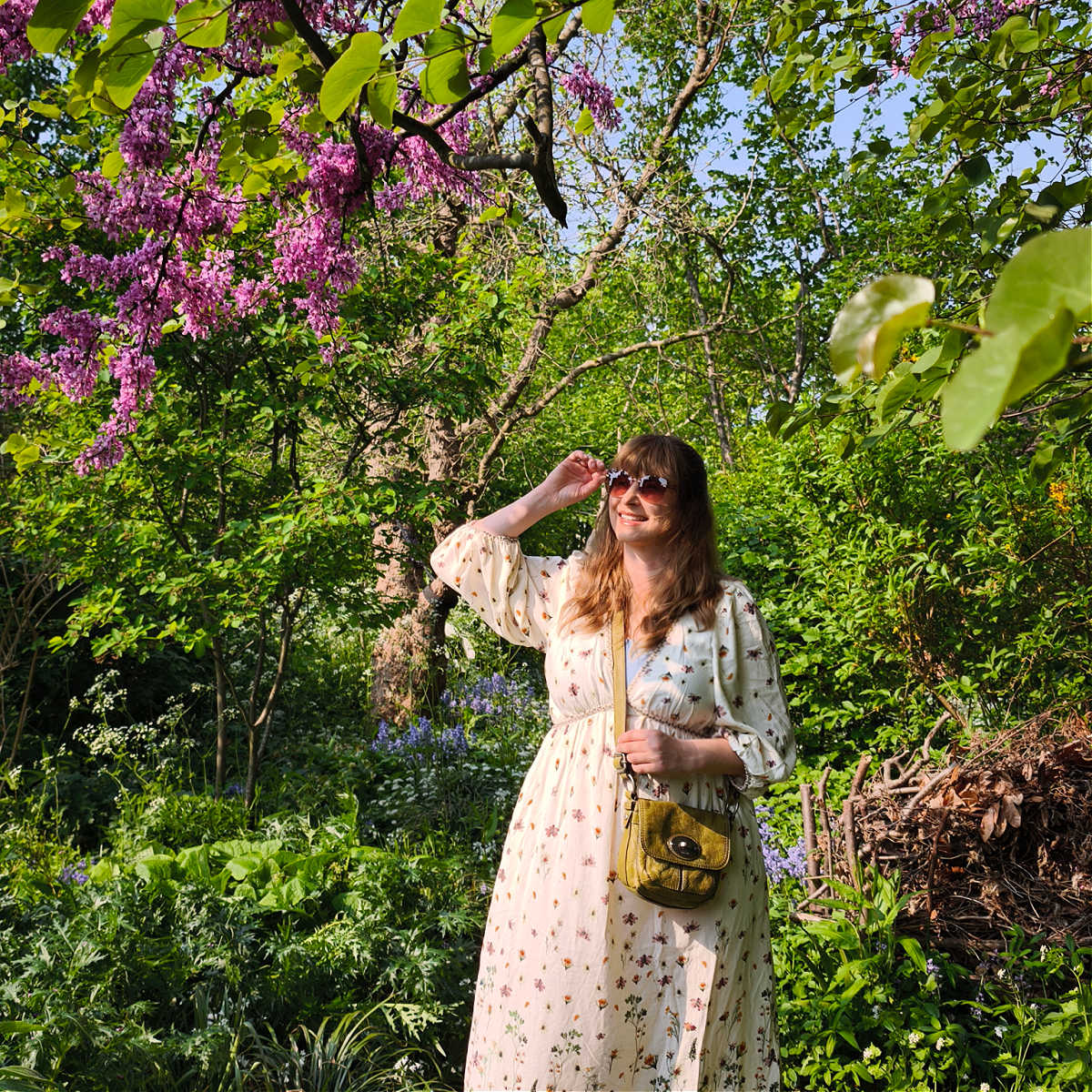
Last time I visited the Red House it was in early spring. We had a great tour guide, who showed us around and you get to see first hand the plans and drawings for the house on display. I used to volunteer at Red House as a gardener for number of years, but because of my work I spend most of my time outside the house. So, to take the tour was a lovely way to remember the house and the special history that comes with it.
Bought by the National Trust only 23 years ago, the house has been slowly revealing its secrets. Recently, a Pre-Raphaelite wall painting was discovered in one of the bedrooms thought to be by Morris and his friends.
Elsewhere, there are wall murals depicting medieval banquets with pictures of Morris, his wife Jane and other figures amid the revellers. Letters from Webb to Morris telling of progress in building the house have been discovered under the floorboards.

Quite what the sturdy locals of Bexleyheath thought of the bohemian lifestyle of Morris and company is not known but we do know that they frequently dressed in medieval costumes and held sumptuous parties in the surrounding garden; indeed Morris writes of being able to open a window and pick apples from his study.
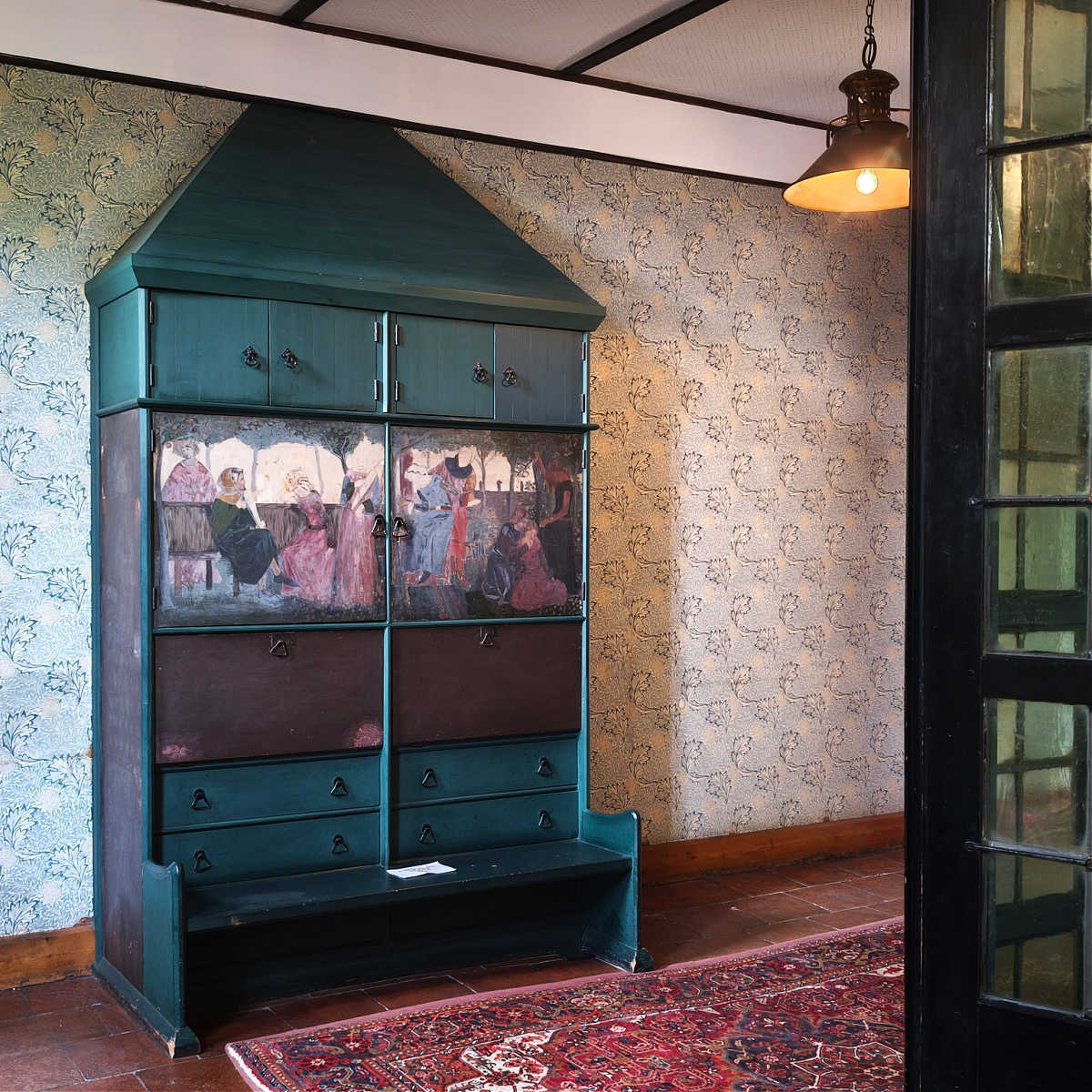
Described by Dante as more of a poem than a home, the immense red-titled steep and high sloping roofs and tall chimney stacks must have been visible for miles around. Inside, there are cupboards painted by Burne-Jones in the hallway and deep red tiles on the floor. The main bedroom wall is covered in a tapestry of embroidered surge – a craft which Morris taught his wife.
William Morris’s most famous quote was ‘have nothing in your house that you do not know to be useful, or believe to be beautiful.’ The Red House was his first and most personal homage to both these ideals.
MORE HISTORIC ATTRACTIONS NEAR BY

The Red House Gardens
The gardens at Red House are by any means large, but fairly substantial for a town house. You can sit in the small orchard, walk around the vegetable and cutting plants plots or walk through the rose ‘tunnel’ with the view of the house.
There is also a ‘woodland’ path around the outskirts of the gardens right next to the fence. The newly installed ‘snug’ garden is also fantastic. It’s a square garden with plants all around it and four simple benches with a tree in the middle. Sitting there, does make you think that you are in the medieval wall painting!
The old pear trees that used to grown by the side of the house, have unfortunately disappeared. Morris originally planted trees very close to the house, so that he could pluck the fresh fruit directly from the house windows. I guess, he didn’t really think that the house foundations or the walls might not necessarily like that few decades later.
Morris never wanted to have a tidy garden, he wanted to have a live, colourful and practical garden where anything goes. This is why you don’t really find here a very neat edges, planting or cute flower bedding borders. Instead, the plants are mainly perennial and have a happy wild look about them!
William Morris’s interesting life & work
What is William Morris remembered for today? He was a man of many parts; poet, political activist and reformer as well as an innovator and tireless champion of a wide range of arts forms such as textiles, wall paper, painting, interior design and architecture.
William Morris, a wealthy middle-class man, was born on March 24, 1834, in Walthamstow, Essex. He attended Exeter College, Oxford, where he developed an interest in Medieval history and architecture.
Morris was heavily influenced by John Ruskin’s philosophy of rejecting the industrial manufacture of decorative arts and architecture in favour of hand-craftsmanship. Morris became the best friend of Edward Burne-Jones, and they shared a keen mutual interest in Arthurianism.
Morris began an apprenticeship with George Edmund Street, a Gothic revival architect, in January 1856. Philip Webb, who became a close friend, supervised Morris during his apprenticeship.
Morris became fascinated with the Pre-Raphaelites and soon met Dante Gabriel Rossetti, one of the foremost Pre-Raphaelite painters. Morris and Burne-Jones moved in together to a flat at No. 17 Red Lion Square in Bloomsbury by November 1856.
In October 1857, Morris met Jane Burden, a woman from a working-class background, at a theatre performance and asked her to model for him. They entered into a relationship and were married in a simple ceremony held at St Michael at the North Gate church in Oxford on 26 April 1859.
MORE PLACES TO SEE AROUND BEXLEYHEATH

Red House plans and construction (1859-60)
Morris decided to construct a house for himself and his bride. He commissioned Webb, who was then setting out as an independent architect, to help him design it.
Morris envisioned Red House as being not only a family home but also a background to his ongoing artistic work. He wanted it to be situated in a rural area that was not far from London, and chose to search in Kent because it was his favourite county. Morris purchased an orchard and a meadow at Upton in West Kent.
While Red House was under construction, Morris and his wife lived in rented accommodations at 41 Great Ormond Street. However, as the project neared completion, the Morrises moved to Amberley Lodge, close to the site, so that Morris could monitor the builder’s progress.
Red House was designed to an L-shaped plan, with two stories and a high-pitched roof made of red tile. The large hall, dining room, library, morning room, and kitchen were located on the ground floor, while on the first floor were situated the main living rooms, the drawing room, the studio, and the bedrooms.
The servants’ quarters were larger than in most contemporary buildings. Windows were positioned to suit the design of the rooms rather than to fit an external symmetry.
The house lacked any applied ornamentation, with its decorative features instead serving constructional purposes, such as the arches over the windows and the louvre in the open roof over the staircase.
According to Morris’ biographer J.W. Mackail, the external design of the house was “plain almost to severity, and depended for its effect on its solidity and fine proportion.”

William Morris’ life at Red House (1860-1865)
Morris only stayed at the Red House for five years before financial pressures forced him to sell up, but during that time he devoted himself to studying and perfecting the artistic techniques that become a hall mark of the Arts and Craft movement. Not only that but he decided that the best way to practice was on the interior of the house itself!
Morris and his wife moved into Red House in May 1860. Morris designed and commissioned furniture for the flat in a Medieval style, much of which he painted with Arthurian scenes in a direct rejection of mainstream artistic tastes. Morris’ life at Red House was a happy one, and he was able to indulge his love of nature and gardening.
He also continued to work on his artistic projects, including designing wallpaper, tapestries, and stained glass windows. Morris and his wife had two daughters, Jenny and May, while living at Red House.
In 1865, Morris and his family left Red House and moved to Queen Square in Bloomsbury. Morris’ reasons for leaving Red House were not clear, but it is believed that he wanted to be closer to his business interests in London.
EXPLORE MORE OF KENT

Red House after Morris & threats of demolition (1934)
In 1934, the Red House faced a possible threat of demolition due to suburban development. The owner, Alfred Herbert Horsfall, attempted to sell the house with an asking price of £4,000.
Concerned with the possible loss of the house, a preservation committee emerged, hoping to donate the property to The National Trust. The committee sought to raise £3,100 to purchase the property from Horsfall.
Despite gaining the support of influential figures such as Rudyard Kipling, George Bernard Shaw, and H.G. Wells, and architects Edwin Lutyens, Giles Gilbert Scott, and Herbert Baker, the committee’s appeal only raised £550 by December 1934.
Red House during Thomas Curtis Hill ownership (1935)
The Trust was unwilling to pay the rest of the amount, and the committee returned the donations that had been offered. The house was eventually purchased by Thomas Curtis Hills, a local estate agent, in 1935, who moved into it with his wife Beatrice Nellie Foster.
During World War II, the government’s Assistance Board took control of the house’s ground floor in 1941, using it as an office to aid those left homeless by The Blitz. The House’s gardens were also used to construct an air raid shelter for the staff.
The Hills were keen to sell the house after the war, and in 1950, they unsuccessfully attempted to sell it to The National Trust and then the Labour Party before offering it for £5,000 to anyone “willing to preserve it for the nation.”
The same year, it was designated a Grade I listed building by English Heritage. The couple moved out of the building in early 1951, and it was left empty for over a year until it was purchased by Richard “Dick” Toms and Edward “Ted” Hollamby in 1952.
The restoration by Richard Toms & Edward Hollamby (1952)
After Richard “Dick” Toms and Edward “Ted” Hollamby purchased the Red House in 1952, they began a restoration project to preserve the building’s heritage. They aimed to restore the house to its original state and used Morris’ original designs to guide their work. The restoration project was completed in 1959, and the house was opened to the public as a museum of Morris’ work.
The National Trust
In 2003, The National Trust took over the management of the Red House, which makes it the the only property in the Trust’s portfolio that was designed and built by Morris.
Practical information for visiting Red House
Address: Red House Lane, Bexleyheath, London, DA6 8JF
Opening Times: March – October (closed during winter season) – Thursdays, Fridays, Saturdays, access is by guided tours only, which need to be pre-booked via National Trust main website. The garden is open during those days and you are welcome to spend time in the Red House grounds (no need to pre-book). The garden is open 11 am – 16.30 pm during the opening days.
Ticket Prices: Adult: £13.00, Child: £6.50, Family: £32.50, National Trust Members: Free
Parking: There is no official parking available at Red House and there are no nearby car parks. There is a very limited on-street parking. The nearest paid car park is at Danson Park, which is about 20 minutes walk.
Danson Park has traditional pub with outdoor (The Stables) seating and also cafe at the Danson House as well as refreshment hut window at the Boat House ( as you are leaving the park to walk towards Red House).
Facilities: Facilities are quite limited. Visitor’s toilets are available, but there is no tearoom or shop (anymore). There is a second hand book shop in the old horse stables (next to the old tearoom and new toilets). Red House is in a residential area of Bexleyheath, so there are no shops, restaurants or cafes directly at streets around the house, but you can find all of these within about 10 minutes walk on the main street walking towards Bexleyheath and then in Bexleyheath Broadway.
How to get to Red House by public transport
Train: Take a train to Bexleyheath Station (from London it’s about 30 minutes or 1 hr and 40 minutes from Canterbury). From the station, it’s about a 20-minute walk to Red House. Alternatively, you can take a bus from the station to get closer.
Bus: From Bexleyheath Station, you can take any bus that’s heading towards Bexleyheath and get off at Upton Road. From there, it’s a short walk to Red House (about 5 -10 minutes).
This blog post was originally published on 14 October 2014 and last updated on 3 May 2025


