Visiting Eynsford Castle: History, Walks, and Where to Visit Nearby
I’ve always had a soft spot for castle ruins, and Eynsford Castle is one of those places that feels like a proper hidden gem. It’s not as famous as some of Kent’s other castles, which actually works in your favour – you’ll often have the place almost to yourself, and there’s something really special about wandering around ancient walls without fighting through crowds.
The castle sits right in the heart of Eynsford village, and whilst it might not have the towers and battlements you’d see at somewhere like Leeds Castle, what’s left is absolutely fascinating. The flint walls are remarkably well-preserved, and you can still get a real sense of what life was like here nearly a thousand years ago.
I’ve first visited the Eynsford castle about 25 years ago and since then I usually visit it when I walk my favourite path from Farningham to Eynsford and the castle is sort of my mid point for break and turning back.
MORE CASTLES IN KENT

My local tips
Here’s what I always tell people: visit on a weekday if you possibly can. Eynsford Castle is managed by English Heritage, and whilst it’s never heaving with tourists, weekends do get a bit busier, especially during school holidays. This is simply because the Eynsford village gets busy and you might not be able to find a parking place so easily. Early morning is particularly lovely – the light catches those old flint walls beautifully, and you might even have the whole place to yourself for a while.
The castle is actually free to enter (yes, really!), but it’s unstaffed, which means there’s nobody there, if you have any questions or need anything. I’d recommend downloading the English Heritage app before you go, or at least having a quick read about the castle’s history. It makes the visit so much more interesting when you understand what you’re looking at.
Wear sensible shoes. The ground is pretty uneven around the castle, and if it’s been raining, it gets muddy. Also, there are no facilities at the castle itself – no toilets, no café, nothing – so sort that out in the village before you head over.
One more thing: if you’re into photography, this place is brilliant. Those Norman walls are incredibly photogenic, and because the castle is essentially a shell, you get these gorgeous views of the sky through the empty window frames.
MORE CASTLES IN KENT
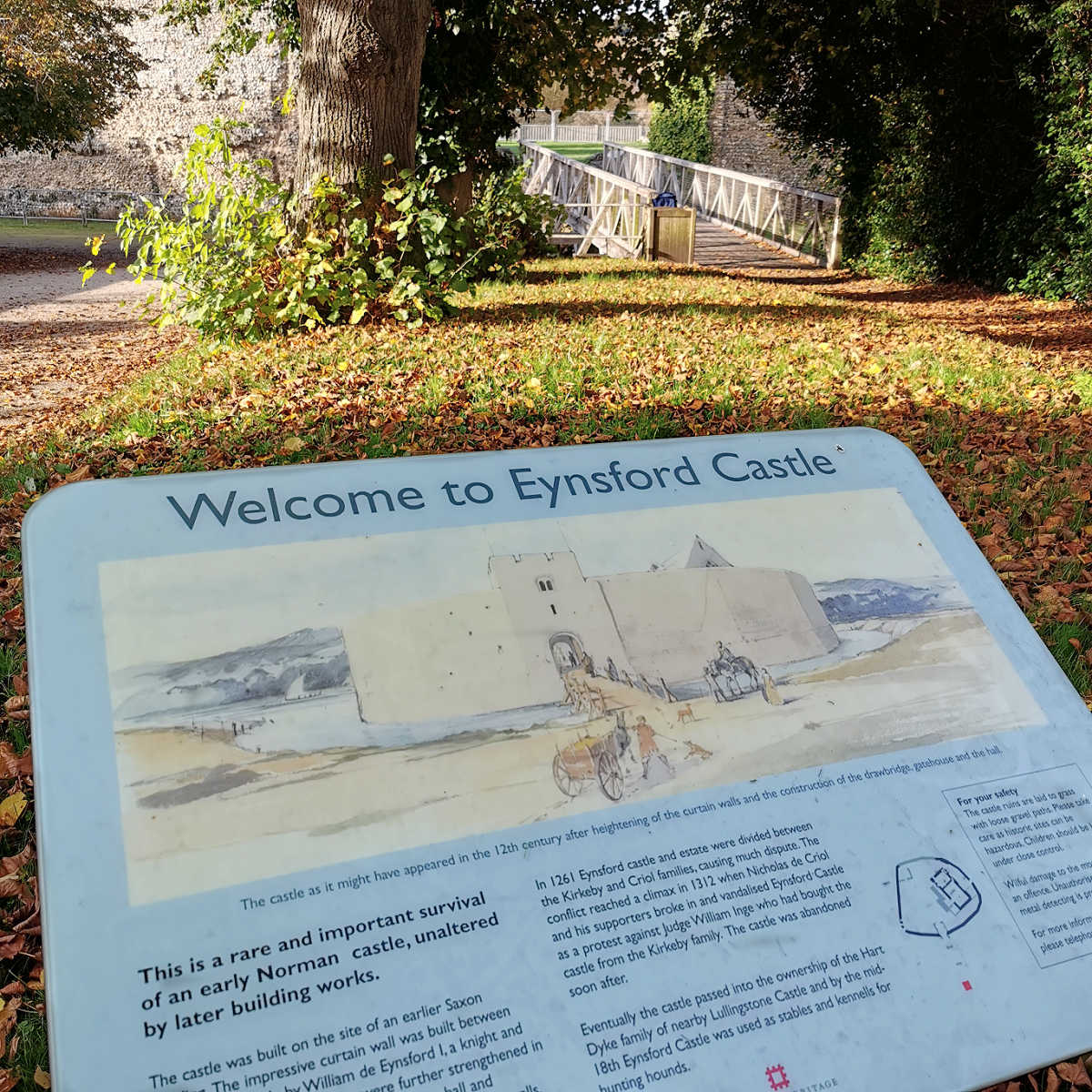
What You Can See at the Eynsford Castle
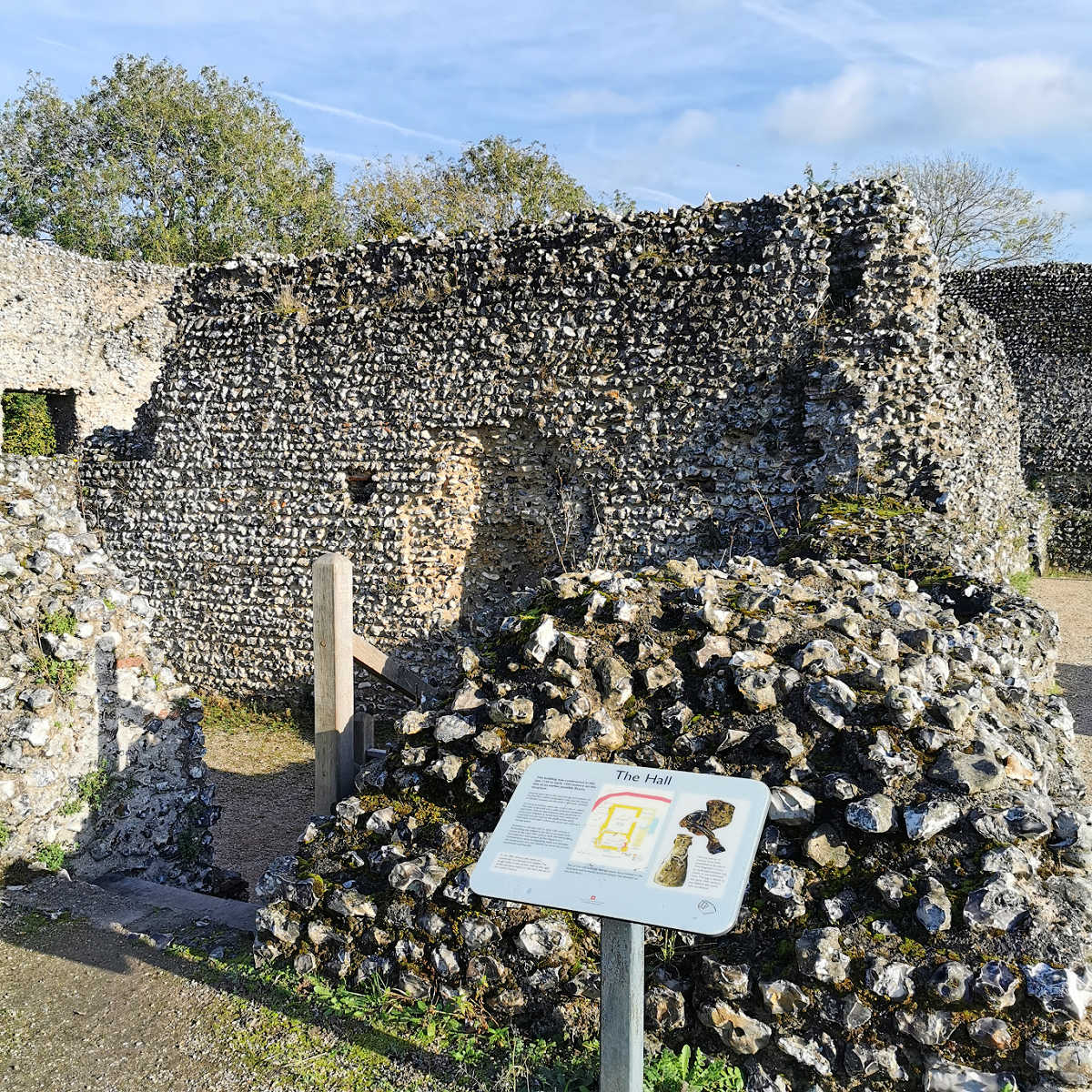
Eynsford Castle is what’s called a shell keep – basically, what remains are the outer walls of a fortified manor house. You’ll find the flint and stone walls standing up to about 30 feet high in places, which is pretty impressive considering they’ve been here since around 1100.
The most striking thing when you walk in is how complete the layout still feels. You can clearly see where the great hall would have been, and there are remains of the living quarters. The walls are thick – really thick – and you can still make out the original Norman windows and doorways.
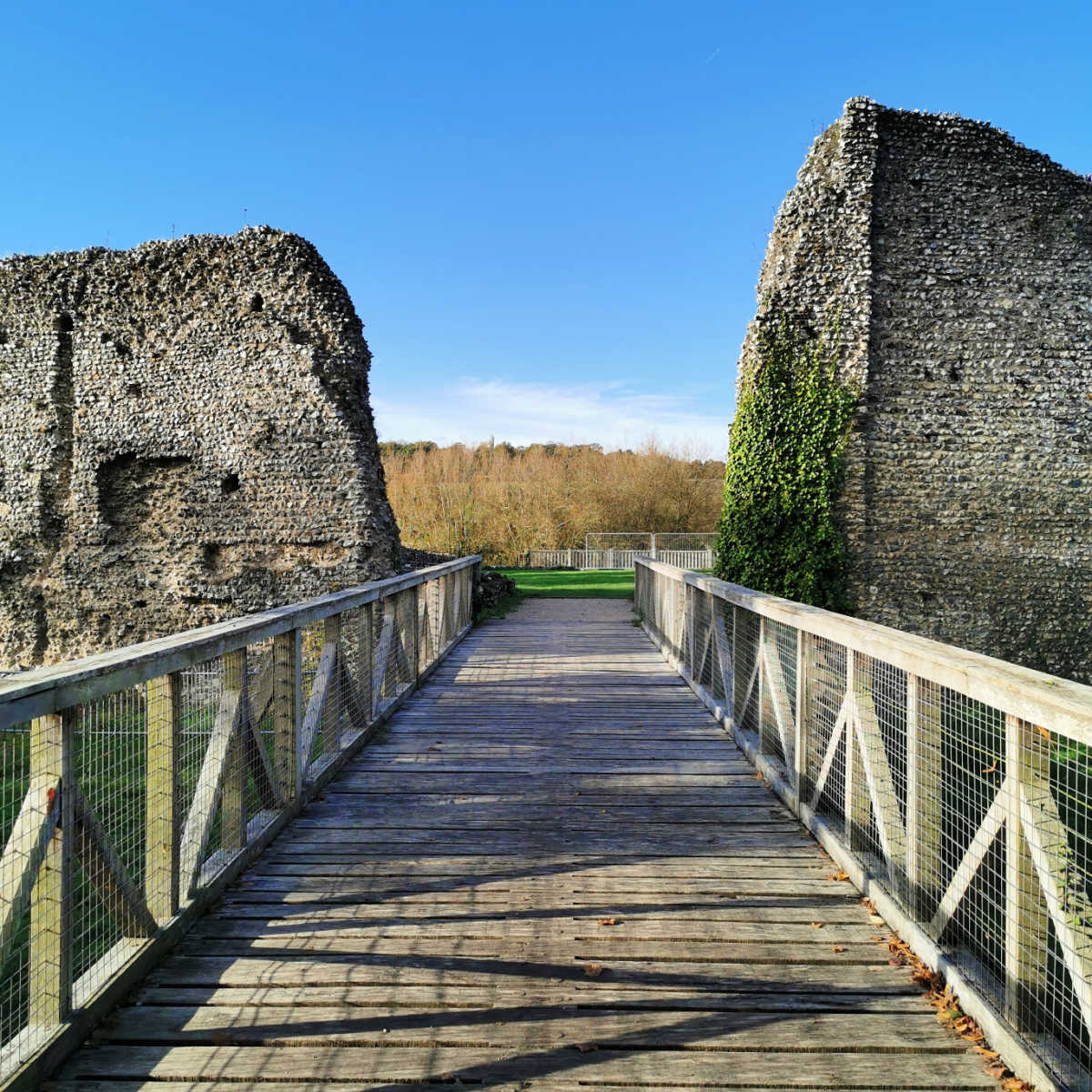
You’ll spot the remains of a first-floor chapel, which is quite rare in buildings of this period. Look for the archway – it’s beautifully preserved. There are also remnants of a stone bridge that would have crossed the moat (long since dried up, unfortunately).
The enclosure isn’t huge – you can walk around the entire site in about ten minutes if you’re rushing – but that’s not really the point. Take your time. Sit on one of the low walls. Look up at where the roof would have been. You can really let your imagination run wild here.
Because it’s open to the elements, the castle has this lovely weathered quality. Wildflowers grow in the cracks during summer, and ivy creeps up parts of the walls. It feels romantic in that proper English ruins sort of way.
MORE CASTLES IN KENT
Eynsford Castle History
Eynsford Castle was built around 1085-1100 by William de Eynsford, shortly after the Norman Conquest. This makes it one of the earliest stone-built castles in England – most castles at that time were still being built from wood, so this was quite a special building even at that time.
The de Eynsford family lived here for about 150 years, and by all accounts, they were a fairly powerful Norman family. The most famous (or perhaps infamous) resident was William de Eynsford II, who had a massive falling out with Thomas Becket, the Archbishop of Canterbury. This was back in the 1160s, and the dispute was over who had the right to appoint the local priest. William ended up being excommunicated, which was a pretty big deal in those days.
The castle was partially destroyed around 1312 during a siege, and after that, it was never properly rebuilt. The de Eynsford family moved out, and the castle gradually fell into ruin. By the Tudor period, locals were apparently using it as a convenient source of building stone, which is why some sections are more ruined than others.
English Heritage took it over in the 1970s and did conservation work to stabilise what was left. They’ve done a brilliant job – the walls are secure, but they haven’t over-restored it. It still feels like a genuine ruin, which I really appreciate.
MORE CASTLES IN KENT
How Long to Allocate for Your Visit
The castle itself won’t take you long – I’d say 30 minutes if you’re having a proper look around and reading all the information boards. If you’re just having a quick wander, you could do it in 15 minutes.
But here’s the thing: Eynsford village is absolutely lovely, and it would be a shame to rush in and out. I’d allow at least two hours for the whole experience – castle, a walk around the village, maybe a drink at the pub. If you’re planning to walk along the river or visit some of the nearby attractions (and I really think you should), then make it a half-day or even a full day out.
The castle is open during daylight hours all year round, which gives you quite a bit of flexibility. In summer, you could easily spend a whole afternoon here, especially if you bring a picnic.
MORE CASTLES IN KENT
Practical Information for Visiting
Location
Eynsford Castle, Castle Paddock, Eynsford, Kent DA4 0AA
Opening Times
The castle is open usually 10-4 pm during winter time and 10-4 pm during summer. Although the entrance is free, the main gate does get locked outside the opening hours.
Admission
Free! One of the best things about Eynsford Castle is that entry is completely free. There’s no ticket office, no turnstile, nothing like that. You just walk in.
Parking
There’s a small free car park in the Eynsford village about 5 minutes walk from the castle. It’s not huge (maybe 15 spaces?) so it gets filled up very quickly especially during weekends. The car park is just off the high street, and it’s well signposted.
How to Get There
By Car
Eynsford is easy to reach by car – it’s just off the M25, which makes it perfect for a day trip from London or anywhere in the South East.
From London and the M25: Take Junction 3 and follow the A20 towards Brands Hatch. After about two miles, turn right onto Hulberry Lane, which takes you into Eynsford. Follow the signs to the castle – it’s well signposted once you’re in the village.
From Sevenoaks: Take the A225 north towards Eynsford. It’s a lovely drive through proper Kent countryside.
From Maidstone: Head north on the M20, then join the M26 westbound. Take the M25 northbound and exit at Junction 3, then follow the directions above.
Sat nav is generally reliable, but if you’re using one, put in “Castle Paddock, Eynsford” rather than just the postcode – it’ll take you right to the car park.
By Public Transport
Eynsford has a railway station with regular services, which makes it surprisingly accessible without a car.
From London: Take a Southeastern train from London Victoria, London Blackfriars, or London St Pancras International to Eynsford. The journey takes about 40-50 minutes depending on which London station you start from. Trains run roughly every hour.
From the station, it’s about a 10-minute walk to the castle. Turn right out of the station, walk down Station Road into the village, and follow the signs. It’s a pleasant walk through the village – you’ll cross the River Darent on the way.
You can also get to Eynsford from Sevenoaks, Dartford, and other nearby towns on the same train line.
Check National Rail or the Southeastern website for current timetables, as they do change. I’d also recommend checking for any planned engineering works if you’re visiting on a weekend.
By Bicycle
If you’re a cyclist, Eynsford is on the Darent Valley Path, which is part of National Cycle Route 12. It’s a lovely traffic-free route along the river valley. You can cycle here from Dartford or Sevenoaks quite easily.

What You Can See Nearby to Make It a Perfect Day Out
What I love about Eynsford is that is surrounded by other fascinating places, so you can easily fill an entire day. Here are my favourite combinations:
Lullingstone Roman Villa (2 miles away)
This is absolutely brilliant and probably my top recommendation for pairing with Eynsford Castle. It’s one of the best-preserved Roman villas in Britain and my favourite roman heritage sites in Kent, with incredible mosaics and the remains of a bath house. The site is run by English Heritage, and unlike the castle, this one has a visitor centre with proper facilities and interpretation.
The villa dates from around 100 AD, and what’s survived is genuinely remarkable – including one of the earliest Christian chapels in Britain. You’ll need about 90 minutes here, and there’s a small admission charge (free if you’re an English Heritage member).
The walk between Eynsford Castle and Lullingstone Villa is gorgeous, too – it’s about 2.5 miles along the Darent Valley Path. If you fancy stretching your legs, this makes for a perfect morning castle visit, riverside walk, then villa visit combination.

Lullingstone Castle & World Garden (2.5 miles away)
Confusingly, this is completely separate from the Roman villa! Lullingstone Castle is actually a grand manor house (not really a castle in the medieval sense) that’s still lived in by the same family who’ve owned it for centuries. The house and gardens are only open on certain days between April and September, so you’ll need to check their website before planning to visit.
The gardens are really beautiful – there’s a lake, a medieval gatehouse, and lovely grounds to wander around. It’s quite a different experience from Eynsford Castle, but if you’re interested in seeing how the other half lived through the centuries, it’s worth timing your visit to coincide with their open days.
Eynsford Village
Don’t overlook the village itself. It’s very picturesque, with a medieval bridge over the River Darent, a lovely church (St Martin’s), and several good pubs. The Plough Inn and The Malt Shovel both do decent food, and there’s are also a couple places to get tea. I usually get a coffee and a homemade sandwich from the Rafferty’s Village Store on the high street close to the Eynsford castle.
The river is beautiful here – crystal clear and shallow enough that kids paddle in it during summer. There are ducks and moorhens, and you can enjoy an ice cream and watch the world go by for a bit sitting by the riverside.
The Darent Valley Path
This is a 19-mile walking and cycling route that follows the River Darent from Dartford to Sevenoaks. The section around Eynsford is particularly lovely. You don’t need to walk the whole thing (though you certainly could), but even a mile or two along the river makes for a gorgeous addition to your visit.
The path takes you through water meadows and past several historic sites. It’s flat, well-maintained, and suitable for all fitness levels. If you walk north from Eynsford, you’ll reach Lullingstone Roman Villa, Lullingstone Country Park, Castle Farm with beautiful lavender fields and eventually reach Shoreham. If you head south, you’ll go through Farningham (another pretty village).

Shoreham (3 miles away)
Speaking of Shoreham, this is another beautiful village worth visiting. It’s known for its medieval church and the remains of a palace that once belonged to the Archbishops of Canterbury. Samuel Palmer, the Victorian artist, lived and worked here, and you can see why – the landscape is gorgeous. I also always pop in to The Mount Vineyard to pick up a bottle of their wine and another coffee for the journey back!
The walk from Eynsford to Shoreham along the Darent Valley Path takes about an hour and makes for a lovely linear walk. You can get the train back from Shoreham station (it’s on the same line as Eynsford).
Brands Hatch (3 miles away)
If you’re into motorsport (or visiting with someone who is), Brands Hatch is just down the road. This is one of Britain’s most famous racing circuits, and on race days, the atmosphere is brilliant. You’ll hear the cars from Eynsford when there’s an event on!
Even if there isn’t a race happening, you can often visit the circuit. They do track days, driving experiences, and sometimes you can just turn up and watch practice sessions. Check their website to see what’s on – if you’re visiting with kids (especially car-mad ones), this could be the perfect addition to your day.
The contrast is quite funny, actually – spending the morning wandering around a nearly thousand-year-old castle, then spending the afternoon watching supercars tear around a racing circuit. Very different periods of history, but both quintessentially British in their own way.

Farningham (2 miles away)
Another lovely Darent Valley village that’s worth a quick stop. There’s a beautiful medieval bridge here (spot a theme?), and the village sits right on the river. The Chequers Inn is a proper old coaching inn if you fancy a drink in historic surroundings.
Farningham also has the Lion Hotel, which does excellent Sunday roasts. If you’re planning a Sunday visit to Eynsford Castle, you could easily incorporate lunch here.
This blog post was originally published on 9 March 2026 and last updated on 9 March 2026


