Bayham Old Abbey: A Local’s Guide to the Free Medieval Ruins Near Lamberhurst
Bayham Old Abbey is such a magical place. The first time I visited was almost 20 years ago, when you still had to pay for a ticket at the little booth and I remember enjoying a quiet walk around the ruins with barely anyone else there.
Fast forward to this year and I rocked up expecting to hand over my card again, only to discover it’s now completely free to visit (yay!). That was a lovely surprise.
A word of warning though: there are no facilities on site. No café, no shop, and sadly no toilets either. So bring a bottle of water and a sandwich, because once you’re there, you’re properly off-grid. But honestly? That’s part of the charm. The site is huge, the ruins are beautiful, and you can wander for an hour without bumping into another soul.

My Honest Review: Is Bayham Old Abbey Worth Visiting?
Yes, especially now it’s free! If you’d asked me whether it would have been worth an imaginary £12 a ticket, I might have hesitated, because Bayham isn’t a polished English Heritage experience. There are no costumed guides, no interactive screens, no gift shop or tearoom.
What you get instead is a genuinely large set of medieval ruins sitting in lovely countryside, with hardly anyone around. If you like your history without the crowds and the gimmicks, you’ll love it. If you need a tea room and a playground to keep everyone happy, skip it and head to Scotney Castle down the road instead.

My Local Tip
Park up, walk in, and immediately turn left towards the gatehouse before you go anywhere near the main church ruins. Most people make a beeline for the big arches, but the gatehouse area is where you get the best sense of how grand this place once was and you’ll usually have it entirely to yourself.
Also: bring a picnic blanket. There are grassy areas around the ruins that are perfect for sitting and eating, and since there’s nowhere to buy food on site, you might as well make a proper afternoon of it.

What to See at Bayham Old Abbey
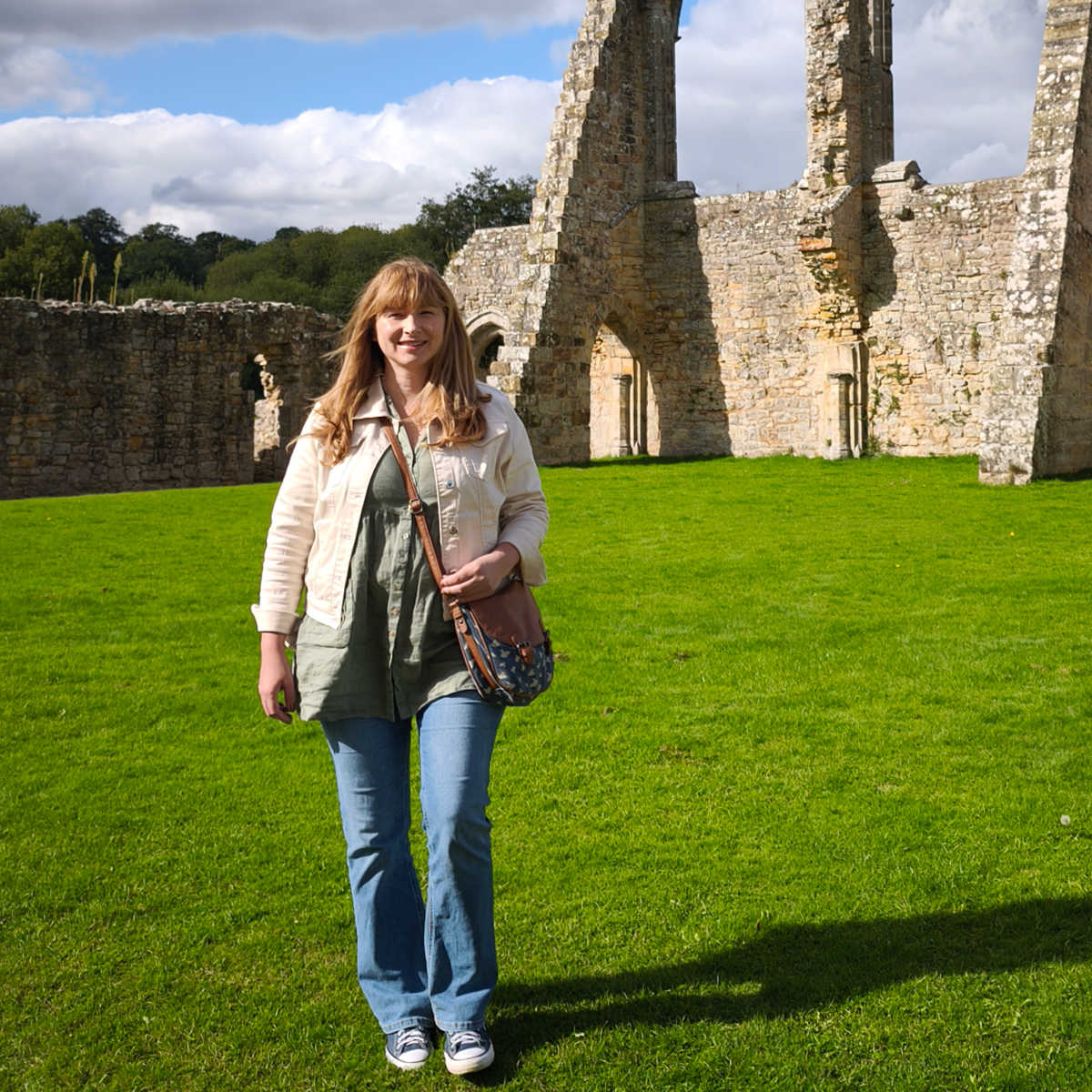
The site is bigger than you’d expect. The main church ruins are what catches your eye first, tall, roofless walls with pointed Gothic arches still standing after 800 years. You can walk right through what was once the nave and into the church transepts.
Look out for the carved stone details around the doorways. Some of the masonry work is incredibly fine, and you can still spot decorative carvings on the column capitals if you know where to look. The chapter house is another interesting area, it’s a smaller space where the monks would have met daily.
The gatehouse on the far side of the site is where the original entrance would have been across the river. There’s also a small section of the cloister wall where you can still see traces of where the monks’ living quarters once stood.
The Dower House is not accessible to public ( I think it’s rented out), but you can see the part that’s backing on to the abbey grounds. Sometimes there is a self-service second hand bookshop room open, where the old ticket office used to be.
Best Time to Visit
Spring and early autumn are ideal. The grounds look beautiful when everything is green, and you avoid the boggy patches that can appear after heavy winter rain. Summer is fine too, but bring sun cream because there’s very little shade among the ruins.
Allow yourself about an hour to an hour and a half. If you’re picnicking and taking your time, stretch it to two hours. Any longer and you’ll have exhausted the site.

The Fascinating History of Bayham Old Abbey
Bayham Abbey was founded around 1207 by the Premonstratensian order, known as the White Canons because of their white woollen habits. It was created by merging two smaller, struggling communities (one at Otham in Sussex and one at Brockley) into a single larger abbey on the Kent-Sussex border. The River Teise actually runs through the site and the boundary between the two counties cuts right across the abbey grounds.
For over 300 years, it was one of the most important religious houses in the south-east. Sadly, Bayham was one of the first abbeys in England to be dissolved, but surprisingly not by Henry VIII! Cardinal Wolsey shut it down in 1525, nearly a decade before the main Dissolution of the Monasteries, to fund his new colleges at Oxford and Ipswich. The locals were furious. There was actually a small uprising where villagers briefly reinstated the canons, but it didn’t last.
After the dissolution, the ruins were left to crumble until the 18th century, when the landowners decided ruined abbeys were terribly fashionable. They landscaped the grounds, built the Dower House and turned the whole thing into a romantic garden. So what you’re seeing today is partly a genuine medieval ruin and partly a carefully curated 18th-century vision of what a medieval ruin should look like!
Planning Your Visit: 2026 Ticket Prices, Opening Times & Location
- Admission: Free
- Opening times: Open daily during daylight hours (the site is unstaffed, so access is generally dawn to dusk)
- Address: Bayham Old Abbey, Bayham Road, Lamberhurst, Kent, TN3 8DE
- Parking: Free on-site car park
- Accessibility: Grassy, uneven terrain — not ideal for wheelchairs, but the main ruins are reachable by a level path
- Dogs: Welcome on leads
Refreshments & Facilities
There is genuinely nothing on site. No toilets, no café, no vending machines. Bring everything you need. When I visited, the only room that was open inside the house was a small second-hand book shop with honesty box (I recognised it as the original ticket office).
For food and drink afterwards, the village of Lamberhurst is about a 5-minute drive away and has a couple of great options. The Brown Trout is a proper country pub doing solid pub food, and The Vineyard at Lamberhurst (part of Chapel Down’s operations) has a lovely café with light lunches and obviously wine tastings. If you fancy something more local-feeling, Lamberhurst Vineyard does pizzas and wine flights in summer, which is exactly the kind of afternoon I’d recommend pairing with the abbey visit.

What Else to See & Do Nearby
Scotney Castle & Gardens is just 10 minutes away by car and is one of my favourite National Trust properties in Kent. You get a moated medieval castle, a Victorian country house and a properly designed garden, all on one ticket. It’s the perfect pairing with Bayham because Scotney has the café and toilets that Bayham doesn’t!
Bewl Water is another 5-10 minutes down the road and is the largest area of open water in the south-east. You can walk, cycle, or even hire a kayak. There’s a café there too if you’ve worked up an appetite.
And for the wine lovers, Lamberhurst Vineyard and Hush Heath Estate are both within a short drive.
This blog post was originally published on 4 June 2026 and last updated on 4 June 2026


