South Foreland Lighthouse: Visiting Guide, History & Local Walks
I was always fascinated by the lighthouses, so when I had the chance to visit the South Foreland Lighthouse, I was really looking forward to the guided tour. You can visit any time of the year to walk around, although if you want to visit the lighthouse inside, you need to plan your visit during the spring, summer or autumn season. But, whichever season you arrive, always wrap up warm as it’s so windy there!
Over the years I’ve visited many times and I usually walk to the lighthouse as part of my favourite walk from St.Margaret’s to Dover from St. Margaret’s village but you can also walk from the White Cliffs of Dover Visitor’s centre.

PLACES TO VISIT CLOSE BY
- Exploring Dover Western Heights Country Park >>
- The fascinating history of 2WW tunnels at Dover Castle >>
Practical Information for Visiting South Foreland Lighthouse (National Trust)
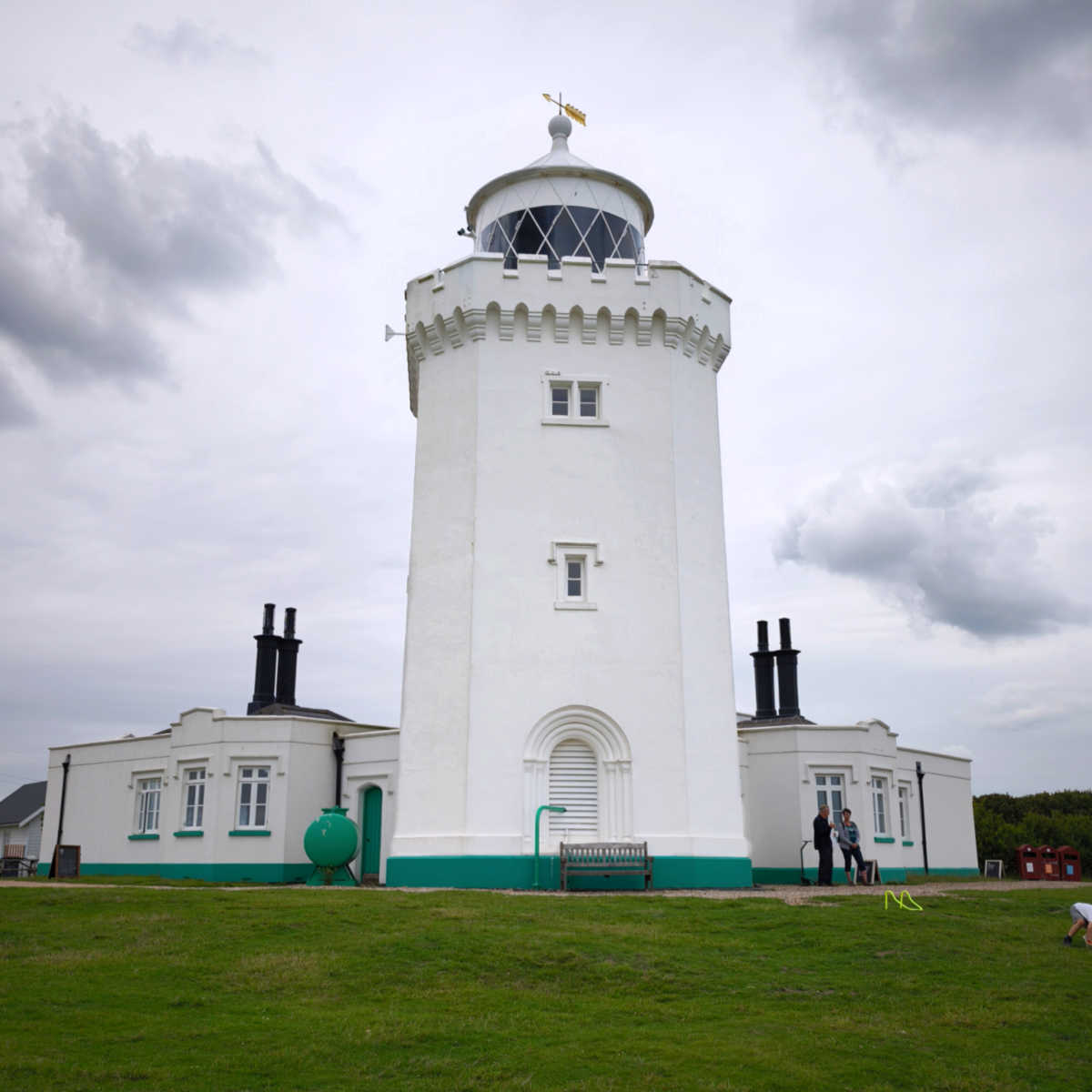
The South Foreland Lighthouse is a popular with walkers, because it’s a good starting point for a coastal walk to Dover and it’s also a great picnic site with a lovely views. You can also visit the inside of the lighthouse and learn more about it’s important role in maritime safety, radio transmissions and being one of the first lighthouses in the world to use electricity.
My favourite part of the lighthouse is of course, the tearoom, which is beautifully decorated with vintage wall paper, old photos and furniture. The tea room used to be run privately, but it’s now run in-house by the National Trust. This means, that unfortunately the homemade cakes have disappeared, but you still get your usual National Trust tearoom cakes, soups and sandwiches, teas and coffees and they are still served in pretty cups and proper tea pots.
I’m very happy that the 1940s decor with the music has been kept from the previous owners, I’ll always remember how amazing it was to find it there after a long walk for the first time back in 2011.
There is a small National Trust shop, toilets and little library hall set up for workshops and book reading. Outside you can have your own picnic on wooden benches, which have a great view of the sea and the fields around the lighthouse.

Location: Saint Margaret’s Bay, Dover, CT15 5NA
Opening Times: Tearoom opens in March at weekends (11 am – 3 pm), The lighthouse opens in April (Monday, Friday, Saturday & Sunday only – until summer holiday when it’s open all week) from 11 am – 5 pm (tearoom is open at the same time and stays open even when the lighthouse is closed during the week). Closed during the winter season (from November – March)
Cost: £8 adult ticket, £4 child and £20 family, National Trust Members: FREE
Parking: There is no parking or official access by car to the lighthouse (although you could drop people off and drive back to the village to park). People with mobility difficulties can park inside the grounds, but you have to contact the lighthouse in advance and arrange permit.

Walking to the South Foreland Lighthouse
I love walking around the White Cliffs of Dover as it’s a completely different type of countryside then inland, where we are. Since there is no parking at the lighthouse, you will need to walk there, but the good thing is that you have a several amazing options here.
You can either park at the White Cliffs of Dover Visitor Centre. The parking here is free if you are a National Trust Member or £6 per day for everyone else. The walk from the visitor’s centre is fairly easy and takes you along the cliff-top marked trail. It’s about 2 miles long and you can return by using the top walk, which is more straight and less up & down kind of path.
Alternatively, you can also park at St Margaret’s Bay (paid car park) and then walk up to the Pines Gardens and St Margaret’s Museum following the Saxon Shore Way long distance path and continuing on along Beach Road. This is about 1 mile long slightly up the hill walk with some sea views on one side and the St.Margaret’s Village on the other.
You can also park slightly further way in St.Margaret’s Village at the free car park next to the town hall, but it’s a steep walk down to the St.Margaret’s Bay at the beginning of your journey, where you pick up the marked Saxon Shore Way and continue to the lighthouse. I’ve done this a few times and aside the steep climb at the end of the walk, I really liked looking around the village and once we had an amazing dinner at the local restaurant, which is sadly now closed.
If you fancy a longer walk the Saxon Shore Way will take you to the pretty Kingsdown Bay Beach, Walmer Castle and the pretty seaside town of Deal.

The South Foreland Lighthouse History
The South Foreland Lighthouse are actually two Victorian lighthouses very close to St. Margaret’s Bay (which is near Dover). They were built to warn ships approaching the nearby Goodwin Sands which can be quite shallow at low tide. The lighthouses have been in use since at least the 1630s, and even after the decommissioning of the Lower Lighthouse, they continued to be used as leading landmarks.
The larger South Foreland Upper Lighthouse was built in 1843 and was the first lighthouse to use an electric light. It went out of service in 1988 and is currently owned and looked after by the National Trust. The site was also chosen by Guglielmo Marconi for his pioneering experiments in wireless radio transmissions.
The South Foreland Lower Lighthouse was built at the same time further down the cliff, to the east, where it still stands. It was decommissioned in 1904 and is now in private ownership. You can see it as you walk to the St. Margaret’s at Cliffe. It sort of looks like a taller band stand with a pretty roof and that’s what I thought it was until recently when I walked passed it and realised that it’s the second smaller lighthouse.
MORE INDUSTRIAL HERITAGE SITES IN KENT


The Lighthouse during the 17th and 18th Century and the Knotts family
The Goodwin Sands have long posed a threat to shipping, and the first record of a warning light being used on the Foreland dates back to Brother Nicholas de Legh, who hung a white light from cliffs near St Margaret-at-Cliffe to the north. Sir John Meldrum built the first pair of lighthouses at South Foreland in 1635, and the light at this time was provided by an open fire burning in a brazier on the roof.
The lighthouses were passed to Robert Osboldston in 1643 and then to Greenwich Hospital in 1715. In 1730, William Knott began his service as the lighthouse keeper at the Lower Lighthouse.
Over the next 175 years, five generations of the Knott family served as lighthouse keepers at South Foreland, making them “probably the longest dynasty of keepers anywhere in the world.” This is where the current lighthouse tearoom name comes from, in case you are wondering.
In 1793, the Upper Lighthouse was rebuilt with an oil lamp and parabolic reflectors in place of the brazier, and the Lower Lighthouse was similarly rebuilt two years later. John Yenn was the South Foreland Lighthouse architect.
South Foreland Lighthouse modern additions during 19th Century
In 1832, the Corporation of Trinity House purchased the lease for the South Foreland lights from Greenwich Hospital. Ten years later, the Upper Lighthouse was heightened and refurbished with a multi-wick oil lamp and a first-order fixed dioptric optic, manufactured by Henry-Lepaute of Paris.
The Lower Lighthouse was entirely rebuilt in 1846 and provided with a fixed array of fifteen Argand lamps and reflectors. The architect and engineer for both these projects was James Walker. At the same time, new accommodation for the keepers was built alongside each tower.
The first use of electric light
In the 1850s, Michael Faraday, scientific adviser to Trinity House, explored the feasibility of electric light being used in lighthouses. Several different solutions were proposed, and in 1857, Frederick Hale Holmes demonstrated his magneto-electric apparatus to Faraday, proposing its use in conjunction with carbon arc lamps.
The initial trial was conducted at South Foreland Upper Light and because of that it became the first lighthouse to use electric light. The South Foreland trial began in December 1858 and continued until early 1860.
Meanwhile, at South Foreland that year, experimental use was being made of a Drummond light at the high lighthouse. In 1871, South Lighthouse became the first to be designed and built for electric operation, and the following year, South Foreland received its own permanent electric installation.
A power station was built, mid-way between the two lighthouses, containing four magneto generators driven by a pair of steam engines with coke-fuelled boilers.
The building also included additional accommodation for the attendants (you can still see the buildings, although they are private and there is no access). At the same time, the two lighthouses were each provided with a medium-sized (third-order) catadioptric fixed optic designed by James Chance.
The lighthouse was electrified in 1875, making it one of the first in the world to use electricity.
MORE INDUSTRIAL SITES IN KENT
The fog signal experiments
In 1873, Professor John Tyndall was engaged by Trinity House to conduct a series of experiments on the relative effectiveness of different types of fog signal.
South Foreland was chosen as the location, and a variety of acoustic instruments were set up at the top and bottom of the cliff, to be monitored from a Trinity House vessel offshore. At first, three systems were tested: a steam whistle, an air whistle, and a pair of air-powered brass trumpets with reeds. Later, other designs of whistle were trialled, as well as a steam ‘syren’ and three types of gun.
Tyndall’s recommendation was that the siren should provide the standard fog signal at major landfall stations, with reeds judged suitable at some sites. In 1876, Tyndall was again engaged to make a comparative study at South Foreland, this time of two different types of electric generator: the magneto and the dynamo.
The trial took place over the winter of 1876–77, and the dynamo was demonstrated to be both mechanically and electrically superior. Later, in 1884, Professor Tyndall again conducted experiments for Trinity House at South Foreland, this time on the relative merits of gas lamps, oil lamps, and electric lamps.
Guglielmo Marconi tests with radio waves
In 1898, South Foreland Lighthouse was used by Guglielmo Marconi during his work on radio waves, receiving the first ship-to-shore message from the East Goodwin lightship on Christmas Eve that year.
The system was used over the following winter to avert several shipwrecks. In 1899, the first international transmission was made between the lighthouse and Wimereux in France.

The lighthouse gradual decline in use and decommissioning
In 1904, the Lower Lighthouse was taken out of commission. The tower was sold, and the attached cottage was used as a holiday home.
The South Foreland lighthouse’s significance continued well into the 20th century, and it was used as a radio station during World War I. It was finally decommissioned in 1988 and purchased by the National Trust, who opened it to the public in 1989.
In 2004, the clockwork mechanism that turns the optic was restored to working order to celebrate the centenary of its installation. The light was reactivated again on 2 June 2022, this time to mark the Queen’s Platinum Jubilee.
After being unlit for several years, the light was reactivated in June 2012 to commemorate the Diamond Jubilee of Elizabeth II.
This blog post was originally published on 11 January 2024 and last updated on 30 July 2025


